The right keyboard stand can make a live setup more stable, comfortable, and faster to manage. This roundup compares 10 options spanning lightweight X-stands, spacious Z-stands, and two-tier designs.
Use the buying guide below to match stand style, capacity, portability, and adjustment range to your keyboard, stage workflow, and performance needs.
Best 10 Keyboard Stands for Live Performances Picks for 2026
Best Value
RockJam Xfinity Double X Keyboard Stand
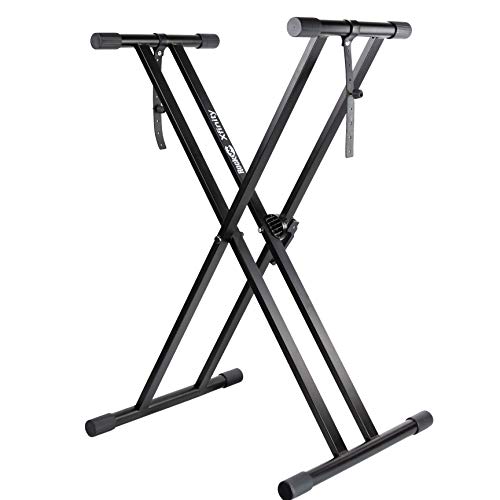
- Pre-assembled setup
- 4–38-inch height adjustment
- Safety lock and straps
Best For: Fast, uncomplicated setups for lessons, home use, and smaller live rigs
Best Premium Rig
Ultimate Support APEX AX-48 Pro Plus

- Two-level professional design
- Includes mic boom and tote
- 250-pound load capacity
Best For: Multi-keyboard or gear-heavy stage setups
Best Heavy-Duty Z Stand
Liquid Stands Adjustable Keyboard Stand

- 250-pound weight limit
- Adjustable height and width
- Includes straps and headphone hook
Best For: Stable seated or standing setups with heavier keyboards or gear
Best Two-Tier Column Stand
Harmony Audio Double Keyboard Stand

- Two-tier keyboard support
- Built-in 5/8-inch mic mount
- 176-pound load capacity
Best For: Dual-keyboard live sets and studio rigs with a microphone
Heavy-Duty Stability

- Steel Z-stand supports up to 220 pounds
- Width adjusts from 22 to 37 inches
- Folding padded arms aid transport
Best For: Gigging players with heavier single keyboards
Expandable Rolling Workstation
Liquid Stands MS1111 Keyboard Stand

- Rolling frame has 3-inch locking wheels
- Supports up to 250 pounds
- Designed for clamps and accessories
Best For: Mobile keyboard and production setups
Two-Keyboard Performance Rig
OnStage KS7365EJ Folding-Z Stand

- Supports two keyboards in one footprint
- Main stand holds up to 400 pounds
- Tool-free disassembly aids transport
Best For: Performers running a double-keyboard rig
Best Adjustable Value
Quick-Release Double-X Keyboard Stand

- Seven height settings with pull-knob adjustment
- Foldable, detachable design for transport
- Locking straps and nonslip covers add stability
Best For: Gigging musicians needing portable height adjustment
Best Heavy-Duty Platform
On-Stage KS7150 Keyboard Stand

- 230-pound stated load capacity
- Adjustable width and independently adjustable legs
- Platform ports support organized cable routing
Best For: Heavy keyboards, mixers, and stage equipment
Best Touring-Grade Choice

- Dual-braced frame supports stable stage use
- Five height positions with locking clutch
- Foldable 3 kg design with locking straps
Best For: Professional and intermediate gigging musicians
Best Value – RockJam Xfinity Double X Keyboard Stand
For keyboard stands for live performances, the RockJam Xfinity offers a straightforward, stable setup for full-size digital pianos. Its pre-assembled double-X frame adjusts from approximately 4 to 38 inches, making it suitable for seated or standing players.
Best For: Gigging musicians, lessons, home practice, and players who want fast setup without tools.
Pros:
- Arrives pre-assembled and unfolds without screws.
- Wide height range supports children through standing adults.
- Safety lock, straps, and non-slip rubber caps improve stability.
- Heavy-duty steel construction supports up to 45 pounds.
Cons:
- Its single-level X-style design offers less flexibility than a two-tier stand.
- The 45-pound capacity may not suit heavier stage gear.
This is a practical, portable choice when quick deployment and basic keyboard stability matter more than advanced rigging options.
Best Premium Rig – Ultimate Support APEX AX-48 Pro Plus
Among keyboard stands for live performances, the Ultimate Support APEX AX-48 Pro Plus stands out for its professional two-level design, quick setup, and included mic boom. It also comes with a tote for transport and storage.
Best For: Performing keyboardists who need a polished stage stand with room for two levels of gear and microphone support.
Pros:
- Two-level tri-bar arms provide adjustable support for multiple pieces of gear.
- Includes a mic boom and professional tote.
- Designed for quick assembly, teardown, transport, and storage.
- Rated for up to 250 pounds.
Cons:
- At 19 pounds, it is heavier than the lighter portable options here.
- The listed warranty is 90 days.
Its combination of two tiers, high load rating, microphone attachment, and carrying tote makes it a strong choice for more elaborate performance setups.
Best Heavy-Duty Z Stand – Liquid Stands Adjustable Keyboard Stand
For keyboard stands for live performances, the Liquid Stands Z-style model provides broad adjustability and a sturdy alternative to common X frames. It fits 54- to 88-key electric pianos and adjusts for seated or standing play.
Best For: Players who need a stable, adaptable stand for keyboards, mixers, turntables, synths, or MIDI equipment.
Pros:
- Height adjusts from 22.5 to 33.5 inches, while width also adjusts.
- Z-style construction is designed to resist tipping better than common X-style stands.
- Supports up to 250 pounds.
- Includes anchoring straps, anti-skid pads, adjustable feet, and a headphone hook.
Cons:
- Its 6.35 kg weight may be less convenient for frequent transport.
- The height range is narrower than the RockJam’s range.
With one-minute setup and flat-pack transport, this stand balances gig portability with substantial support for heavier instruments and equipment.
Best Two-Tier Column Stand – Harmony Audio Double Keyboard Stand
For keyboard stands for live performances, the Harmony Audio Double Keyboard Stand offers a two-tier column layout with a built-in 5/8-inch mic mount. Its vertical-column design gives performers space for two keyboards or synths without using a conventional X frame.
Best For: Live players and studio musicians building a compact two-keyboard setup with convenient microphone attachment.
Pros:
- Two levels accommodate synths or digital pianos.
- Integrated 5/8-inch mic mount supports convenient microphone placement.
- Aluminum construction keeps the design suited to stage and studio use.
- Supports up to 176 pounds.
Cons:
- The lower capacity is below the 250-pound ratings of some alternatives.
- The two-tier layout may be more stand than needed for a single keyboard.
This is a focused option for performers who want dual-keyboard capacity and microphone integration in a column-style stage rig.
Heavy-Duty Stability – Roland KS-11Z Keyboard Stand
For keyboard stands for live performances, the Roland KS-11Z is built for players who want a sturdy, adjustable setup for an 88-note stage piano or other keyboard. Its steel construction, padded support arms, and adjustable rubber feet make it practical for venues where stability and quick transport matter.
Best For: Gigging keyboardists using heavier keyboards and needing broad width and height adjustment.
Pros:
- Heavy-duty steel construction supports up to 220 pounds.
- Quick-release lever provides seamless width adjustment from 22 to 37 inches.
- Adjustable rubber feet improve stability on uneven flooring.
- Folding padded support arms simplify transport and storage.
Cons:
- Its 220-pound capacity is lower than some heavier-duty multi-keyboard stands.
- The Z-stand design may be more substantial than needed for lightweight keyboards.
With a 25- to 36-inch height range and a 22- to 37-inch width range, the KS-11Z offers useful flexibility without sacrificing its heavy-duty focus. It is a strong choice for a single-keyboard live rig that must be stable yet fold down for transport.
Expandable Rolling Workstation – Liquid Stands MS1111 Keyboard Stand
Among keyboard stands for live performances, the Liquid Stands MS1111 stands out as a rolling, expandable platform for keyboards, synths, mixers, and related gear. Its locking wheels, accessory-ready frame, and 250-pound load limit make it suited to setups that need more than a basic keyboard support.
Best For: Performers and production users who want a mobile keyboard station with room for accessories and additional equipment.
Pros:
- 3-inch locking wheels support convenient movement and positioning.
- 250-pound weight limit accommodates substantial gear.
- Height adjusts from 26 to 36.5 inches.
- Multiple rivnuts and through holes support bolts, screws, clamps, and compatible attachments.
Cons:
- At 27 pounds, it is less lightweight than a simple folding stand.
- Its rolling workstation format may be more equipment than a minimalist live setup requires.
- Accessories and tabletop components may require separate configuration.
The MS1111 is especially flexible for performers who combine a keyboard with production hardware, speakers, or a second tier. Locking casters and security straps add practical stage utility, while the included 10-year warranty provides long-term support.
Two-Keyboard Performance Rig – OnStage KS7365EJ Folding-Z Stand
For keyboard stands for live performances that need to hold two instruments, the OnStage KS7365EJ provides a double-keyboard configuration in a single-stand footprint. Its adjustable Z-style frame disassembles without tools, making it a practical option for performers who need substantial capacity and portable setup.
Best For: Keyboardists performing with two keyboards, digital pianos, synthesizers, or organs.
Pros:
- Main stand supports up to 400 pounds, while the second tier supports 60 pounds.
- Holds two keyboards without requiring separate stand footprints.
- Main height adjusts from 23.5 to 36.5 inches.
- Disassembles quickly without tools for storage and transport.
Cons:
- The 29.5-pound frame is heavier than many single-keyboard stands.
- The second tier is limited to 60 pounds.
- A two-tier design may be unnecessary for players using only one keyboard.
With a 21- to 36-inch width adjustment and an angle-adjustable second tier, the KS7365EJ is designed around a flexible two-keyboard workflow. Its high main-load capacity and tool-free disassembly make it particularly well suited to demanding live rigs.
Best Adjustable Value – Quick-Release Double-X Keyboard Stand
For keyboard stands for live performances, this foldable double-X model is a practical choice when you need fast height changes and straightforward transport. Its seven height positions, pull-knob adjustment, and locking straps support 54-, 61-, and 88-key electronic pianos.
Best For: Gigging musicians who want a lightweight, adjustable stand for performances, rehearsals, and home storage.
Pros:
- Seven adjustable height positions accommodate different playing setups.
- Double-X steel construction, thickened rods, and nonslip covers promote stability.
- Folds and detaches for easier transport and compact storage.
- Locking straps help keep the keyboard from shifting during use.
Cons:
- The notes do not provide a specific load-capacity rating.
- Its X-frame design provides one support level rather than a table-style platform.
This stand balances portability and adjustability well. It is especially appealing for performers who regularly move between venues and need a simple, tool-free-style setup with added keyboard retention.
Best Heavy-Duty Platform – On-Stage KS7150 Keyboard Stand
Among keyboard stands for live performances, the On-Stage KS7150 stands out for its platform-style support and stated 230-pound capacity. Adjustable width and height make it suitable for large keyboards, organs, synths, electric pianos, mixers, and other substantial stage equipment.
Best For: Performers and studios using heavy or wide-format keyboards and gear that benefit from a level, table-style platform.
Pros:
- Supports equipment weighing up to 230 pounds.
- Width adjusts for different instruments and more efficient floor use.
- Each leg adjusts independently to level the platform on uneven surfaces.
- Rubber feet and support braces help maintain stability, while platform ports organize cables.
Cons:
- At 7.3 kg, it is heavier than the listed double-X alternatives.
- Its platform format may be less compact for musicians prioritizing minimal packed size.
The KS7150 is the strongest fit here for demanding equipment and stable, table-like support. Choose it when load capacity, leveling, and cable management matter more than carrying the lightest stand.
Best Touring-Grade Choice – Kadence NK13WH Double-X Stand
For keyboard stands for live performances, the Kadence NK13WH combines a touring-oriented dual-braced frame with five height positions and a reinforced locking clutch. Its foldable 3 kg design is aimed at musicians who need secure support for 61-, 76-, and 88-key keyboards across gigs, rehearsals, and studios.
Best For: Intermediate and professional performers seeking a compact, stage-focused stand with locking straps and reinforced stability.
Pros:
- Dual-braced X construction is designed to reduce wobble during intense playing.
- Five height levels support seated or standing performance setups.
- Locking straps help prevent keyboard movement or slipping.
- Folds for transport and requires no assembly, with a durable powder-coated steel build.
Cons:
- The 25 kg load capacity is lower than the KS7150’s stated 230-pound capacity.
- The matte white finish may be less visually neutral than a black stand in some stage setups.
The NK13WH is a well-rounded touring option when portability and secure keyboard retention are priorities. Its white finish, reinforced frame, and quick setup also give it a distinctive stage presence.
How We Picked These Keyboard Stands for Live Performances
We focused on practical requirements for gigging musicians: stability, weight capacity, height adjustment, setup speed, portability, and compatibility with common 49-, 61-, and 88-key keyboards. The selection includes single-tier and two-tier stands, X and Z frames, platform-style designs, and models with useful additions such as microphone or boom attachments.
Because stage conditions vary, no single design is ideal for every performer. A compact X-stand may be best for quick changes and smaller rigs, while a Z-style or platform stand generally provides more legroom and support for heavier digital pianos.
Quick Comparison
| Stand type | Best for | Main advantage | Potential drawback |
|---|---|---|---|
| Single X | Portable gigging | Fast folding and easy transport | Can offer less legroom and lateral stability |
| Double X | Budget-conscious performers | Added bracing and broad compatibility | May interfere with seated playing |
| Z-style | Digital pianos and studio rigs | Strong support and adjustable clearance | Usually bulkier than X-stands |
| Two-tier | Players using multiple keyboards | Creates a second playing level | Heavier and slower to configure |
| Platform-style | Large or heavy keyboards | Wide, stable support surface | Less compact for travel |
Key Buying Factors for Keyboard Stands for Live Performances
Weight Capacity and Frame Stability
Check the stand’s stated capacity against the keyboard’s weight, particularly with an 88-key stage piano or digital piano. Leave practical headroom for vigorous playing and accessories. Locking braces, wide feet, and padded contact points can reduce movement and protect the instrument.
Height and Playing Position
Choose a stand that supports your preferred seated or standing position. Wide adjustment ranges are useful when sharing equipment, but confirm that the frame remains stable at the height you plan to use. If you play seated, inspect the lower frame for knee and pedal clearance.
Portability and Setup Speed
For frequent gigs, folding dimensions, total weight, and the locking mechanism matter as much as maximum capacity. Pre-assembled or quick-release designs can save time during changeovers. Measure your vehicle and storage space before choosing a large Z or platform stand.
Single-Tier Versus Two-Tier Layouts
A second tier is useful for synths, controllers, or a compact backup keyboard, but it adds weight and changes access to controls. Confirm the upper tier’s width, height, and load rating rather than assuming it will fit every instrument.
Who Should Buy Which Keyboard Stands for Live Performances?
- Traveling performers: Choose a folding X or double-X stand when low weight, quick setup, and easy transport are priorities.
- 88-key stage-piano players: Consider a heavy-duty Z-style or platform stand with generous width, clearance, and load capacity.
- Multi-keyboard musicians: A two-tier stand can reduce floor space and keep both instruments within reach.
- Players who need a microphone solution: Models with a boom or microphone mount can simplify compact stage setups, though dedicated mic stands may offer more placement flexibility.
- Home-to-stage users: Favor adjustable designs that provide comfortable practice height while folding small enough for transport.
Before buying, verify the exact dimensions and capacity for your keyboard, bench, pedals, and cables. A stand that fits the instrument securely and suits your playing posture will usually be more valuable than one with the lowest price or the highest advertised capacity.