Velocity-sensitive pads make sampled drums, one-shots, and melodic parts respond more naturally to how hard you play. The right sampler or pad controller can turn a basic beat into a more expressive performance while fitting your workflow, budget, and setup.
This roundup compares 10 options ranging from standalone sampling units and multipads to compact USB and wireless MIDI controllers. Consider pad response, connectivity, software support, portability, and onboard features before choosing.
Best 10 Samplers with Velocity Sensitive Pads Picks for 2026
Portable MPC Pick

- 16 responsive MPC pads
- Battery-powered standalone operation
- Sampling, chopping, resampling, and effects
Best For: Portable beatmaking and DAWless production
Live Performance Powerhouse

- Nine velocity-sensitive RGB pads
- Built-in looper and sample loading
- 32GB storage with over 6GB of content
Best For: Live looping and expressive electronic drumming
Software Controller Value

- 16 MPC-style velocity-sensitive pads
- 48 assignable pad locations
- MPC Beats and Ableton Live Lite included
Best For: Computer-based beatmaking and sample triggering
Expandable Drum Pad
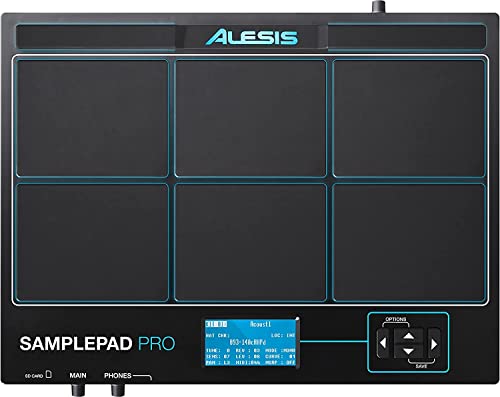
- Eight velocity-sensitive illuminated pads
- Kick, hi-hat, and extra pad inputs
- 200+ sounds with SD card expansion
Best For: Electronic drumming and expandable live percussion
Compact Sample Controller

- Eight backlit velocity- and pressure-sensitive pads
- SD-card playback for 16-bit mono WAV samples
- USB MIDI, standard MIDI, and balanced audio outputs
Best For: Portable finger drumming and sample triggering
Full Drum Multipad

- Nine dual-zone velocity-sensitive pads
- Up to 592 sounds and 30 preset drum kits
- Trigger inputs, MIDI, USB, and custom kit storage
Best For: Electronic drumming and expandable percussion setups
Wireless RGB Pad Controller

- Sixteen RGB velocity pads with aftertouch
- Bluetooth and USB MIDI connectivity
- Up to 15 hours of battery-powered use
Best For: Mobile production, wireless triggering, and DJ performance
Best Mobile Pick
JP-MINI Wireless MIDI Pad Controller

- 16 RGB velocity-sensitive pads with aftertouch
- Wireless MIDI or USB-C connectivity
- Rechargeable, 150 g portable design
Best For: Mobile finger drumming and portable sample triggering
Best Value Control
Donner STARRYPAD MIDI Beat Maker

- 48 assignments across three pad banks
- Faders, knobs, buttons, and MIDI in/out
- Includes Cubase LE, WaveLab LE, and Melodics
Best For: Beginners wanting versatile wired MIDI control
Best Feature-Rich Portable

- 16 RGB pads with aftertouch and three curves
- Eight assignable knobs and DAW transport controls
- Up to 10 hours of battery life with wireless MIDI
Best For: Portable production and expressive live performance
Portable MPC Pick – MPC Sample
The Akai Professional MPC Sample is a strong option for anyone seeking samplers with velocity sensitive pads in a compact, standalone format. Its rechargeable battery, speaker, microphone, built-in storage support, and MPC workflow make it practical for creating beats away from a computer.
Best For: Portable beatmaking, finger drumming, DAWless creators, beginners, and experienced MPC users.
Pros:
- 16 responsive MPC pads support expressive finger drumming.
- Battery-powered standalone operation includes a speaker and internal microphone.
- Includes chopping, resampling, time-stretching, repitching, and onboard effects.
- USB-C audio/MIDI, MIDI connectivity, and microSD storage support flexible setups.
Cons:
- MIDI DIN connection requires a separately available 1/8-inch adapter.
- Its compact 2.4-inch display may feel limited for detailed editing.
Choose this model when portability and a complete MPC-style workflow matter more than having a large screen or extensive physical controls. It is especially appealing for fast sampling and sketching ideas anywhere.
Live Performance Powerhouse – Strike Multipad
The Alesis Strike Multipad is built for expressive live work, combining samplers with velocity sensitive pads, RGB lighting, looping, and broad sound storage. Its nine pads and large content library make it suitable for triggering one-shots, loops, drums, and melodic parts from one performance-focused unit.
Best For: Live performers, electronic drummers, loop-based musicians, and producers who want extensive onboard sounds.
Pros:
- Nine velocity-sensitive RGB-lit pads provide clear, expressive triggering.
- Includes a built-in looper for recording pad performances or external audio.
- 32GB of storage holds more than 6GB of included loops, drums, percussion, and melodic sounds.
- Offers USB audio/MIDI, sample loading, five effects processors, and assignable controls.
Cons:
- Its 14.2-by-13.8-inch footprint is less portable than compact pad controllers.
- At 3.5 kg, it is comparatively substantial for transport.
This is the most performance-oriented choice in the group. Its illuminated pads, looper, storage, and effects provide a broad toolkit for playing complete parts live rather than simply controlling software.
Software Controller Value – MPD218
The Akai Professional MPD218 is a straightforward USB controller for producers who want samplers with velocity sensitive pads without buying a standalone sampling workstation. Its 16 MPC-style pads, three banks, note repeat, and included software make it a compact way to trigger drums, samples, and effects in a computer-based setup.
Best For: Bedroom producers, beatmakers, DJs, and computer-based music production.
Pros:
- 16 thick MPC pads expand to 48 assignable pad locations through three banks.
- USB-powered design keeps the setup compact and simple.
- Includes note repeat, full level, and 18 assignable knobs across three banks.
- Software bundle includes MPC Beats, Ableton Live Lite, and Drum Synth 500.
Cons:
- It is a MIDI controller, so sampling and sound generation depend on connected software.
- USB connectivity is the primary connection, with iOS use requiring a separately sold Camera Connection Kit.
The MPD218 makes sense when you already produce on a computer and want familiar MPC-style pad control at a lower-complexity entry point. It is less suitable for computer-free sampling, but efficient for triggering software instruments and samples.
Expandable Drum Pad – SamplePad Pro
The Alesis SamplePad Pro is a practical performance sampler for drummers and percussionists who want samplers with velocity sensitive pads, dedicated pedal connections, and expandable sounds. It combines eight illuminated pads with built-in kits, external pad inputs, and SD card storage for live use.
Best For: Electronic drummers, percussionists, live performers, and players building custom drum kits.
Pros:
- Eight isolated velocity-sensitive pads include active blue LED illumination.
- Supports two additional drum pads, kick pedal, and hi-hat pedal connections.
- Provides more than 200 built-in sounds organized into 10 ready-to-play kits.
- SD card support allows up to 512 sounds and 20 kits per 32GB card.
Cons:
- SD card is not included.
- It has fewer onboard pads than the nine-pad Strike Multipad.
- Its feature set is oriented toward drum and percussion performance rather than broad MPC-style production.
Select the SamplePad Pro if external triggers and pedal inputs are important to your playing. It offers a focused drum-performance layout with useful expansion and sample storage rather than a general-purpose beatmaking workflow.
Compact Sample Controller – Akai MPX8
The Akai Professional MPX8 is a compact choice among samplers with velocity sensitive pads, combining eight backlit pads with SD-card sample playback and USB/MIDI connectivity. It is designed for triggering drum hits, melodies, basslines, and other WAV samples in studio or live setups.
Best For: Finger drumming, portable sample triggering, and controlling software or external MIDI gear.
Pros:
- Eight backlit velocity- and pressure-sensitive pads support expressive playing.
- Loads 16-bit mono WAV samples from SD or SDHC cards up to 32GB.
- Includes USB MIDI, standard MIDI input and output, balanced outputs, and a headphone jack.
- Sample kit editor provides tuning and reverb controls for customizing sounds.
Cons:
- Internal sample playback supports mono WAV files rather than a broader range of formats.
- Sample assignments have a listed 30MB maximum.
- Pressure data is sent as MIDI polyphonic aftertouch and does not affect internal sample playback.
The MPX8 favors straightforward sample triggering in a small, lightweight enclosure. Its eight pads and flexible MIDI connections make it practical for beat making, while the SD-card workflow suits users who want a dedicated hardware sampler without a large interface.
Full Drum Multipad – LEKATO PD705
The LEKATO PD705 is a full-featured option among samplers with velocity sensitive pads, offering nine dual-zone pads, a large preset sound library, and support for custom kits. Its trigger inputs and MIDI connections also make it suitable for expanding a percussion setup.
Best For: Electronic drumming, expanded percussion rigs, and performers who want onboard sounds plus custom sample support.
Pros:
- Nine dual-zone velocity-sensitive pads cover drum and percussion parts.
- Provides up to 592 preset percussion sounds and 30 drum kits.
- Supports two additional dual-zone trigger pads or acoustic drum triggers.
- USB-B, five-pin MIDI, SD-card, USB-drive, and WaveManager support add configuration flexibility.
Cons:
- At 3.17 kg, it is less lightweight than compact pad controllers.
- The feature set may be more extensive than needed for simple sample triggering.
- Software and firmware resources require consulting the manufacturer’s FAQ materials.
The PD705 is built more like an electronic drum multipad than a basic MIDI trigger surface. Its dual-zone pads, trigger expansion, preset library, and custom-kit storage make it a strong fit for players who need a broader performance-oriented percussion system.
Wireless RGB Pad Controller – Mini 16-Pad MIDI Controller
This mini wireless MIDI controller is a flexible option among samplers with velocity sensitive pads, pairing 16 RGB pads with aftertouch, Bluetooth MIDI, and USB MIDI. Its rechargeable battery and app-based mapping make it convenient for mobile production, live triggering, and compact studio workflows.
Best For: Mobile beat making, wireless sample triggering, DJ performance, and users who want customizable pad mappings.
Pros:
- Sixteen RGB velocity-sensitive pads include aftertouch for expressive control.
- Bluetooth and USB MIDI support cable-free or wired operation.
- Built-in battery provides up to 15 hours of continuous use.
- Software and mobile app support custom mappings, MIDI commands, velocity curves, and lighting.
Cons:
- It is a MIDI controller rather than a standalone sampler with described onboard sample storage.
- Setup customization depends on compatible PC or mobile software.
- The compact layout uses three pad banks to provide up to 48 assignable pad positions.
The controller’s main advantage is portability: it combines expressive pads, wireless connectivity, and long battery life in a small format. Choose it when you want to control a DAW, synth, or loop software from a phone, tablet, computer, or live rig rather than load samples directly into the hardware.
Best Mobile Pick – JP-MINI Wireless MIDI Pad Controller
For mobile beat makers seeking samplers with velocity sensitive pads, the JP-MINI offers 16 RGB pads in a compact, wireless-friendly controller. It sends MIDI to a computer, phone, or tablet, so you will need compatible music software or virtual instruments to produce sound.
Best For: Portable finger drumming, sample triggering, and mobile MIDI setups.
Pros:
- 16 pads with four velocity curves and polyphonic aftertouch or channel pressure.
- Wireless MIDI or USB-C connectivity across Windows, macOS, iOS, Android, and HarmonyOS.
- Compact 150 g design with rechargeable battery and useful Note Repeat controls.
Cons:
- Has no built-in sounds and requires a DAW, sampler, or virtual instrument.
- Lightning devices require a separately sold adapter.
The JP-MINI is a strong choice when expressive pads and portability matter more than onboard production features. Its aftertouch, velocity options, and wireless operation suit quick sample-based sessions away from a desktop.
Best Value Control – Donner STARRYPAD MIDI Beat Maker
The STARRYPAD is a practical option for producers comparing samplers with velocity sensitive pads and wanting extra hands-on controls. Its 16 silicone pads can trigger drums, samples, and effects, while three pad banks expand the setup to 48 assignable pads.
Best For: Beginners and home producers who want pads, faders, knobs, and bundled learning software.
Pros:
- 16 backlit pads with adjustable velocity curves and three banks for 48 assignments.
- Adds two faders, two knobs, three buttons, and MIDI in/out for broader control.
- Includes Cubase LE, WaveLab LE, and Melodics course access.
Cons:
- Requires DAW software or another sound source and does not produce audio alone.
- iPhone and iPad use requires a separately purchased Lightning adapter.
- The editor handles pad settings but does not record or arrange music.
With its expanded pad banks and physical controls, the STARRYPAD offers more assignment flexibility than a basic pad grid. It is especially appealing if you want a wired controller and software bundle for getting started.
Best Feature-Rich Portable – Donner STARRYPAD PRO
The STARRYPAD PRO combines samplers with velocity sensitive pads and broader production control in a portable format. Its 16 RGB pads add polyphonic aftertouch, while eight assignable knobs and wireless MIDI support make it suitable for both desktop and mobile workflows.
Best For: Producers who need expressive pads, extensive parameter control, and portable use.
Pros:
- 16 velocity-sensitive RGB pads with polyphonic aftertouch and three velocity curves.
- Eight assignable knobs plus DAW transport, pad library, and knob library functions.
- Built-in battery offers up to 10 hours, with wireless MIDI or USB-C connections.
Cons:
- Requires DAW software to generate sound and has no standalone audio output described.
- Wireless and mobile compatibility may still depend on the connected device and software.
The PRO model is the most capable pick here for users who want expressive performance and substantial parameter mapping without giving up portability. Its battery, aftertouch, and eight knobs make it a flexible controller for production, practice, and live work.
How We Picked the Best Samplers with Velocity Sensitive Pads
We selected these products to cover the main ways musicians use pad-based sampling gear: standalone performance, electronic drumming, computer-based beat making, and portable MIDI control. We considered the number and feel of the pads, velocity sensitivity, pad layout, connectivity, assignable controls, onboard sounds or sampling features, and compatibility with common music software.
The list includes dedicated samplers, drum multipads, and MIDI pad controllers. That distinction matters: a MIDI controller generally needs a computer, tablet, or sound module, while a standalone sampler or multipad may provide sounds, effects, triggering, and performance functions without additional equipment.
Quick Comparison
- Best for standalone sampling: Look for internal memory, onboard sequencing, effects, and direct audio connections.
- Best for electronic drumming: Choose a multipad with responsive velocity sensing, durable construction, multiple trigger inputs, and useful drum sounds.
- Best for computer production: USB MIDI controllers offer straightforward DAW integration, flexible mapping, and lower cost.
- Best for portable setups: Compact wireless or USB-C models can work well with laptops, tablets, and mobile devices.
Key Buying Factors for Samplers with Velocity-Sensitive Pads
Pad Response and Playing Feel
Velocity sensitivity controls how loudly or intensely a sound responds to your strike. Look for adjustable sensitivity, consistent triggering across all pads, low latency, and enough playing surface for your technique. Aftertouch can add another layer of control, but it is not included on every model.
Standalone Operation Versus MIDI Control
If you want to sample and perform without a computer, prioritize onboard sounds, audio inputs, storage, sequencing, and effects. MIDI controllers are often more flexible for software instruments and DAWs, but they depend on a connected host and may not generate sound on their own.
Connectivity and Compatibility
Check for USB MIDI, traditional MIDI ports, Bluetooth MIDI, audio outputs, and any required adapters. Confirm that the device works with your operating system, preferred DAW, mobile device, or drum module. Wireless convenience is useful, but wired USB usually provides the simplest and most dependable connection.
Controls, Expansion, and Portability
Knobs, faders, assignable buttons, and display controls can speed up live manipulation and mixing. For drummers, external trigger inputs and pedal connections may be more important than extra software controls. Also consider power requirements, size, mounting options, and whether the unit can withstand regular transport.
Who Should Buy Which Samplers with Velocity Sensitive Pads?
Choose a standalone sampler if you want an all-in-one instrument for triggering samples, building patterns, and performing without relying on a computer. Choose an electronic multipad if your priority is finger drumming, percussion performance, or expanding a drum kit with additional triggers.
Choose a USB MIDI pad controller if you already produce in a DAW and want expressive pads at a reasonable price. Choose a wireless or compact controller if you make beats on the go or need a small setup for a laptop, tablet, or mobile performance. Before buying, match the pad layout and connection options to the software and playing style you use most.