The best voice recorders with external microphone input give you more control than basic built-in-mic devices. You can connect lavalier, XLR, or TRS microphones for cleaner speech, better placement, and more flexible recording setups.
This roundup includes compact handheld recorders, multitrack podcasting tools, and high-capacity digital voice recorders. The right choice depends on your microphone type, recording environment, file-quality needs, and how much hands-on control you want.
Best 10 Voice Recorders with External Microphone Input Picks for 2026
Best for Multi-Person Podcasts

- Four XLR inputs with phantom power
- Four individually controlled headphone outputs
- Mix-minus for phone and remote interviews
Best For: Group podcasts, interviews, and remote recording
Best Compact Stereo Option

- 32-bit float recording for clip-free audio
- X/Y stereo microphones for voices and ambience
- USB-C microphone mode for calls and streaming
Best For: Solo creators and portable stereo recording
Best Adjustable Mic Recorder

- 3.5mm stereo MIC/EXT IN with plug-in power
- Adjustable AB/XY condenser microphones
- 32-bit float recording and USB-C interface mode
Best For: Field recording with flexible mic options
Best XLR Lavalier Bundle

- Two XLR/TRS combo inputs
- Includes two wired XLR lavalier microphones
- Four-track 32-bit float recording
Best For: Video production and XLR lavalier recording
Best High-Capacity Pick

- 128GB storage with up to 9,296 hours in MP3
- 1536kbps WAV recording with noise cancellation
- Voice activation, password protection, and file organization
Best For: Long lectures, meetings, and interviews
Best Expandable Recording Setup

- Four inputs and four-track recording
- Interchangeable X/Y stereo microphone capsule
- Includes lavalier mic, 32GB card, batteries, and tripod
Best For: Field recording, video production, and multi-mic sessions
Best Easy-Use Long-Battery Pick

- Up to 68 hours of continuous recording
- 1536kbps PCM with dual noise-reduction microphones
- One-click recording and USB-C file transfer
Best For: Lectures, meetings, and extended interviews
Best Complete Recording Bundle

- Two XLR/TRS inputs plus a 3.5mm mic/line input
- 32-bit float, four-track recording up to 96kHz
- Includes card, batteries, cables, headphones, and stand
Best For: Creators wanting a ready-to-use external-mic recording kit
Best Accessible Handheld Recorder

- Two XLR/TRS inputs for mics, instruments, and mixers
- Four-track 32-bit float recording with stereo microphones
- USB-C recording, streaming, and spoken menu guidance
Best For: Creators needing flexible inputs and accessible operation
Best Adjustable-Mic Field Recorder
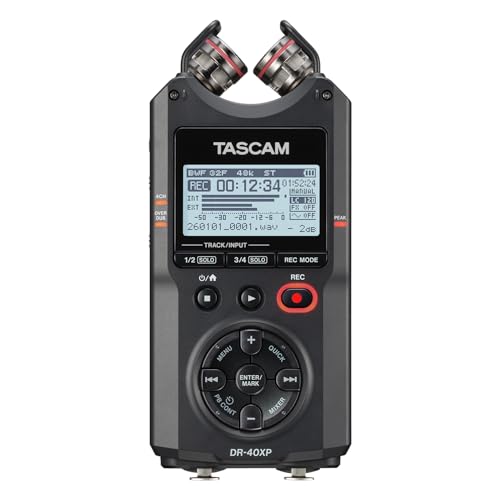
- Two XLR/TRS inputs with adjustable A-B or X-Y microphones
- Four-channel recording captures built-in and external sources
- 32-bit float recording and USB-C audio interface
Best For: Location recording, music, and video production workflows
Best for Multi-Person Podcasts – PodTrak P4
The Zoom PodTrak P4 is a strong choice among voice recorders with external microphone input when you need several microphones and headphones in one portable setup. It provides four XLR inputs with phantom power, making it suitable for group podcasts, interviews, and other multi-speaker recordings.
Best For: Podcasters and interviewers recording multiple guests, phone calls, or remote contributors.
Pros:
- Four XLR microphone inputs with phantom power
- Four headphone outputs with individual volume controls
- Automatic mix-minus supports phone and remote interviews
- Works as a 2-in/2-out USB audio interface
Cons:
- Battery life is rated at up to 3.5 hours on two AA batteries
- Its multi-input design may be more capability than a solo recorder needs
Choose the PodTrak P4 if flexible connectivity matters more than a minimal footprint. Its four-input layout and separate headphone controls make it especially practical for collaborative recording.
Best Compact Stereo Option – Zoom H1 Essential
The Zoom H1 Essential is a compact stereo recorder for creators who want clear voice capture without a larger production setup. While its supplied notes emphasize built-in X/Y microphones, USB-C microphone mode also makes it useful for calls, livestreams, voiceovers, and mobile recording.
Best For: Solo creators, interviewers, students, and anyone recording voices or stereo sound on the go.
Pros:
- 32-bit float recording helps provide clip-free audio
- Built-in X/Y microphones capture natural stereo sound
- USB-C microphone mode supports calls, streaming, and computer recording
- Lightweight 92 g design with up to 10 hours of digital recording time
Cons:
- Supplied details do not list an external microphone input
- Uses two AAA batteries
The H1 Essential is best viewed as a simple, portable stereo recorder rather than a traditional external-mic-input model. Its 32-bit float recording and USB microphone mode make it appealing for quick, polished voice and content work.
Best Adjustable Mic Recorder – TASCAM DR-07XP
The TASCAM DR-07XP is a versatile pick among voice recorders with external microphone input, combining adjustable stereo microphones with a 3.5mm MIC/EXT IN jack. It supports 32-bit float recording, plug-in power, and USB-C interface operation for recording voice, music, meetings, and video audio.
Best For: Users who want built-in adjustable microphones plus the option to connect a compatible external mic.
Pros:
- 3.5mm stereo MIC/EXT IN jack with plug-in power
- Adjustable AB/XY condenser microphones
- 32-bit float, 24-bit, 16-bit, and MP3 recording options
- Up to 17.5 hours of operation with two AA alkaline batteries
Cons:
- Memory card is not included
- External input is a 3.5mm jack rather than an XLR connection
The DR-07XP offers a useful middle ground: it can record immediately with its adjustable stereo microphones, yet still accepts an external microphone through the 3.5mm input. Its long stated battery runtime is another advantage for extended field sessions.
Best XLR Lavalier Bundle – Zoom H4essential
Zoom H4essential 4-Track Handy Recorder with 2X Wired XLR Lavalier Microphone XM-L2
Check Price On AmazonThe Zoom H4essential bundle is designed for users who need external microphone input and hands-free voice capture. It includes two XLR/TRS combo inputs, a 3.5mm mic/line input, and two wired XLR lavalier microphones, while 32-bit float recording helps reduce the need for manual gain adjustment.
Best For: Video creators, interviewers, and small productions using XLR lavalier microphones or other professional audio sources.
Pros:
- Two XLR/TRS combo inputs with Zoom preamps
- Includes two wired XLR lavalier microphones
- 32-bit float, four-track recording
- Built-in X/Y microphones capture sources up to 130 dB SPL
Cons:
- The bundled lavalier microphones require 48V phantom power
- Bluetooth control and timecode require the optional BTA-1 adapter
- The supplied listing provides limited battery-life information
This bundle stands out when you want a recorder and XLR lavalier microphones together. It offers more connection flexibility than a basic handheld recorder, with built-in microphones available when you need a quick standalone setup.
Best High-Capacity Pick – EVIDA 128GB Voice Recorder
For shoppers comparing voice recorders with external microphone input, the EVIDA 128GB model is a practical option for lectures, meetings, and interviews, although its supplied specifications list only a built-in microphone. It combines PCM recording, voice activation, playback, and substantial storage in a compact design.
Best For: Students, teachers, business users, and writers who need long recording capacity and organized file storage.
Pros:
- 128GB storage supports up to 9,296 hours in MP3 format.
- Records in MP3 or 1536kbps WAV and includes noise cancellation.
- Voice activation, password protection, A-B repeat, bookmarks, and four-folder file management.
- Up to 54 hours of continuous recording and USB computer transfer.
Cons:
- The supplied details specify a built-in microphone rather than an external microphone input.
- No headphones jack is listed.
- Its 1.5-inch screen may feel small for browsing files.
The EVIDA is strongest when storage capacity, straightforward playback, and long battery life matter more than multi-input recording. Verify microphone connectivity before buying if an external mic is essential.
Best Expandable Recording Setup – Zoom H5 Portable Recorder Kit
Among voice recorders with external microphone input, the Zoom H5 is the most capable choice here for users who need flexible microphone setups. It includes an interchangeable X/Y capsule, four inputs, multitrack recording, and a lavalier microphone in this accessory bundle.
Best For: Content creators, videographers, interviewers, and musicians who need multiple inputs and hands-on recording controls.
Pros:
- Four-input, four-track portable recorder supports more involved recording setups.
- Interchangeable XYH-5 stereo capsule provides phase-accurate 90-degree stereo capture.
- Bundle includes a lavalier condenser microphone, 32GB memory card, batteries, charger, and tripod/handgrip.
- Large gain knobs, record-arm controls, hold switch, and tripod mounting support practical field use.
Cons:
- It is more complex and less pocket-friendly than a basic lecture recorder.
- The listed digital recording time is 6.67 hours.
- The supplied details do not specify battery runtime or recording resolution.
The H5 is the clear fit when external microphone flexibility and input expansion are priorities. Its included accessories make it a ready-to-use field kit, though casual note-taking may not require this level of control.
Best Easy-Use Long-Battery Pick – Tonfarb 136GB Voice Recorder
For buyers seeking voice recorders with external microphone input, the Tonfarb A20 offers useful everyday recording features, but its supplied specifications identify a built-in microphone rather than an external input. Its one-click controls, noise reduction, and long battery life suit lectures, meetings, and interviews.
Best For: Users who want simple operation, extended recording time, and convenient USB-C file transfers.
Pros:
- 136GB total stated storage supports up to 9,775 hours in MP3 format.
- 1536kbps PCM recording, dual noise-reduction microphones, and voice activation.
- Up to 68 hours of continuous recording from the rechargeable 1100mAh battery.
- One-click recording, USB-C transfer, password protection, and A-B repeat.
Cons:
- The supplied details list a built-in microphone, not an external microphone input.
- The 1.44-inch screen is relatively small.
- The included 128GB TF card and 8GB built-in storage may require checking for exact storage configuration.
The Tonfarb emphasizes convenience: push-button recording, strong battery endurance, and ample storage. It is a sensible general-purpose recorder, but confirm external microphone compatibility before choosing it for microphone-based setups.
Best Complete Recording Bundle – Zoom H4essential Podcast Kit
For shoppers seeking voice recorders with external microphone input, this Zoom H4essential bundle combines two XLR/TRS combo inputs with a broad accessory package. Its 32-bit float, four-track recording is designed to help capture clean audio for podcasts, interviews, music, and field work without manual gain adjustment.
Best For: Podcasters, interviewers, and musicians who want an external-mic recorder with cables, headphones, storage, batteries, and a tabletop stand included.
Pros:
- Two locking XLR/TRS inputs support external microphones, instruments, and other sources.
- 32-bit float recording with dual A/D converters helps prevent clipped takes.
- Bundle includes a 64GB card, rechargeable batteries, charger, XLR cables, headphones, wind protection, and stand.
- Can operate for up to 10 hours on AA batteries or USB-C power and work as a USB audio interface.
Cons:
- The extensive bundle may be more equipment than casual users need.
- Requires four AA batteries when used away from USB-C power.
This is the most ready-to-use option of the three, especially for creators building a portable podcast or interview setup. Its included accessories and multiple input types add flexibility, while the 32-bit float workflow reduces concern about setting recording levels.
Best Accessible Handheld Recorder – Zoom H4essential
The Zoom H4essential is a practical choice among voice recorders with external microphone input, offering two XLR/TRS connections alongside built-in stereo microphones. Its four-track, 32-bit float design suits podcasts, interviews, music, video audio, and live performances, while USB-C adds recording and streaming options.
Best For: Musicians, podcasters, filmmakers, and users who value guided operation and the ability to connect external microphones, instruments, mixers, or soundboards.
Pros:
- Two XLR/TRS inputs allow connection of external microphones, instruments, mixers, or soundboards.
- Four-track 32-bit float recording helps accommodate both quiet dialogue and loud performances.
- USB-C supports recording or streaming to a phone, tablet, or computer while also saving to an SD card.
- Spoken menu guidance can make operation more accessible, including for visually impaired users.
Cons:
- The product listing specifies two AA batteries, so battery capacity is more limited than the bundled four-battery setup of the other Zoom listing.
- Accessories such as microphones, cables, and storage are not identified as included in the supplied notes.
This is a strong all-purpose recorder for users who want flexible external inputs without giving up built-in stereo capture. Its accessibility features and direct USB-C connectivity make it particularly appealing for guided workflows and mobile production.
Best Adjustable-Mic Field Recorder – TASCAM DR-40XP
The TASCAM DR-40XP is a versatile pick among voice recorders with external microphone input, pairing two XLR/TRS inputs with adjustable built-in condenser microphones. It records up to four channels, allowing the onboard mics and external sources to be captured together for music, interviews, and audio-for-video work.
Best For: Musicians, location recordists, and video creators who want adjustable A-B or X-Y stereo microphones plus simultaneous external-input recording.
Pros:
- Two XLR/TRS inputs support external microphones and other compatible sources.
- Adjustable A-B or X-Y microphones provide flexible stereo recording approaches.
- Four-channel recording can combine the built-in microphones and external inputs.
- 32-bit float recording, low-noise HDDA preamps, and USB-C interface support streamlined production.
Cons:
- microSD card and batteries are not included.
- The supplied notes do not specify a bundled microphone or accessory kit.
The DR-40XP stands out for location workflows that benefit from changing the stereo microphone orientation or recording internal and external sources simultaneously. Budget separately for storage and batteries, but the four-channel layout and USB-C interface offer substantial production flexibility.
How We Picked the Best Voice Recorders with External Microphone Input
We selected models that offer a practical way to connect an external microphone, whether through a 3.5mm input, XLR/TRS combo jacks, or dedicated podcasting connections. We also considered recording quality, portability, ease of use, storage, power options, monitoring, and suitability for interviews, lectures, music, filmmaking, and online content.
The list includes both purpose-built handheld field recorders and simpler digital voice recorders. Because their designs differ, check the specifications carefully before buying: an advertised microphone accessory does not always mean the recorder supports every microphone type or plug-in-power requirement.
Quick Comparison
| Best For | Look For | Recommended Type |
|---|---|---|
| Interviews and lectures | Simple controls, long battery life, voice activation | Compact digital voice recorder |
| Podcasts and remote interviews | Multiple inputs, headphone monitoring, mix-minus features | Podcast recorder |
| Music and filmmaking | XLR/TRS inputs, adjustable gain, low-noise preamps | Handheld field recorder |
| Unpredictable recording levels | 32-bit float recording | Modern field recorder |
Key Buying Factors for Voice Recorders with External Microphone Input
Microphone Compatibility
Confirm the connector and power requirements before ordering. A 3.5mm input commonly suits lavalier microphones, while XLR/TRS combo inputs support professional microphones, mixers, and line-level sources. Condenser microphones may require plug-in power or phantom power, depending on the model.
Recording Format and Level Protection
WAV recording preserves more editing information than compressed formats such as MP3. 32-bit float models are especially useful for field work because they provide greater protection against badly set input levels, although microphone placement and room acoustics still matter.
Inputs, Outputs, and Monitoring
For solo interviews, one external input may be sufficient. Podcasting or music projects often benefit from two or more inputs, separate gain controls, and headphone monitoring. Check whether the recorder can monitor incoming audio without distracting latency.
Storage, Battery, and Handling
Look for removable memory, USB-C connectivity, rechargeable options, and a battery life that matches your typical sessions. Physical buttons, a readable display, a windscreen, and a tripod mount can be more valuable in the field than a long list of advanced features.
Who Should Buy Which Voice Recorders with External Microphone Input?
Choose a compact digital voice recorder if your priority is straightforward lecture, meeting, or interview recording with minimal setup. Pick a handheld field recorder with XLR/TRS inputs if you record music, documentaries, live events, or film audio and need microphone flexibility.
A podcast recorder is the better fit for multi-person conversations, remote calls, and productions requiring several headphones or microphones. Choose a 32-bit float model when recording conditions are unpredictable or when you want a forgiving workflow during fast-moving shoots. Before purchasing, match the recorder to your microphone, accessories, storage needs, and editing workflow—not just its advertised recording hours.