A good DI box turns an instrument’s unbalanced output into a balanced signal that travels cleanly to a mixer, audio interface, or stage snake. The best compact DI boxes also help manage hum, impedance, gain, and routing without taking up valuable pedalboard or gig-bag space.
This roundup covers passive and active models, single- and dual-channel designs, and options with useful features such as attenuation, merge switching, phantom-power support, and stereo connectivity.
Best 10 Compact Di Boxes Picks for 2026
Rugged Passive Pick

- Passive mono DI with custom transformer
- Rugged stainless-steel I-beam construction
- For guitars, basses, keyboards, and drum machines
Best For: Live and studio instrument connections
Simple Road-Ready Choice

- Converts 1/4-inch TS to balanced XLR3M
- Passive, plug-and-play operation
- Metal build for live use
Best For: Basic instrument-to-mixer or PA connections
Dual-Channel Active Option

- Active conversion with two XLR outputs
- -15 dB pad for high-output sources
- Ground lift and stated sub -99 dB noise floor
Best For: Live, PA, monitor, club, and DJ systems
Flexible Passive Utility

- Passive, no-power operation
- 1/4-inch input and through jacks
- Pad switch and ground lift included
Best For: Guitar and keyboard signal routing
Most Flexible Compact DI Box

- Three power options: phantom, battery, or USB
- Dual channels preserve stereo separation
- Ground lift and polarity reversal controls
Best For: Stereo keyboards, synths, and flexible live setups
Best Lightweight Compact DI Box

- Lightweight 13.4-ounce enclosure
- Input attenuator supports signal matching
- Hum cancellation and ground-lift function
Best For: Individual guitars, basses, keyboards, and simple PA connections
Best Simple Compact DI Box
Passive Direct Box with Merge Function

- Passive conversion to balanced XLR output
- Ground lift helps reduce connection hum
- Attenuation switch aids level matching
Best For: Live sound, DJ systems, clubs, and PA connections
Stage-Ready Hum Control
Donner Special-I Passive DI Box

- Transformer isolation helps reduce hum and buzz
- Balanced XLR output with instrument or line input support
- Thru connection routes signal to an amplifier
Best For: Compact stage and studio signal matching
Two-Channel Value Pick
Pyle-Pro PDC22 Dual Passive DI Box
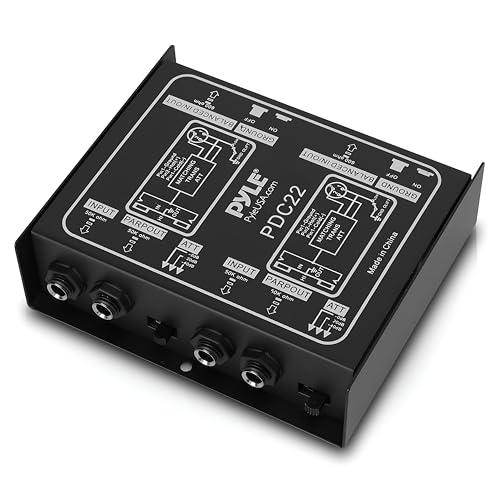
- Two passive DI channels in one unit
- Connects instruments and unbalanced audio sources
- Steel chassis with hum-cancellation capability
Best For: Live or recording setups needing two DI channels
Feature-Packed Pedal

- Three selectable gain levels for signal matching
- Cabinet simulator supports direct guitar and bass tones
- Compact zinc-alloy pedal-style enclosure
Best For: Guitarists and bassists wanting gain and cab simulation
Rugged Passive Pick – Radial Pro DI
The Radial Pro DI is a practical choice among compact di boxes for musicians who need a durable passive mono interface. Its transformer-based design suits live or studio use with guitars, basses, keyboards, drum machines, and professional snake systems.
Best For: Live and studio instrument connections where rugged construction and passive operation are priorities.
Pros:
- Passive mono design requires no stated external power source.
- Custom transformer helps interface instruments with balanced XLR systems.
- Rugged I-beam and stainless-steel construction is suited to regular use.
- Works with guitars, basses, keyboards, and drum machines.
Cons:
- Provides one audio circuit and mono output.
- Passive design may offer fewer controls than an active DI.
Choose this model when build quality and straightforward transformer-based operation matter more than extra channels or active features.
Simple Road-Ready Choice – Hosa Sidekick DI
The Hosa Sidekick is one of the most straightforward compact di boxes for converting an unbalanced 1/4-inch TS instrument signal to balanced XLR. Its passive, plug-and-play design is useful for routing guitars, basses, or keyboards to mixers and PA systems.
Best For: Musicians and performers who need an uncomplicated passive connection from an instrument to a mixer or PA.
Pros:
- Converts unbalanced 1/4-inch TS signals to balanced XLR3M.
- Passive design requires no external power.
- Helps reduce noise on long cable runs.
- Robust metal construction is suited to live-performance use.
Cons:
- Offers a single direct-box channel.
- Its listed connector setup is focused on 1/4-inch TS input to XLR output.
The DIB-443 is a sensible compact solution when you want basic signal conversion and noise reduction without adding a powered or feature-heavy box.
Dual-Channel Active Option – Compact Active DI Box
This compact active DI box is designed for guitars, basses, keyboards, and DJ equipment. It adds two XLR outputs, a -15 dB pad, and ground lift, making it a flexible choice among compact di boxes for managing hot signals and reducing hum in live or installed systems.
Best For: Live sound, PA, monitor, club, and DJ setups that benefit from active signal conversion and dual outputs.
Pros:
- Active design converts high-impedance unbalanced signals to low-impedance balanced XLR.
- Dual 3-pin XLR outputs support two-channel operation.
- -15 dB pad helps manage high-output instruments.
- Ground lift and a stated noise floor below -99 dB help address hum and background noise.
Cons:
- The supplied notes do not specify the power source.
- Its listed weight is 19.4 pounds, which may be less convenient for portable setups.
Consider this model if you need active conversion, attenuation, and ground-loop management in one compact-format unit, while confirming the power requirements before purchase.
Flexible Passive Utility – Yovus DB-1 DI
The Yovus DB-1 is a compact passive DI for connecting an instrument through 1/4-inch input and through jacks to balanced or unbalanced XLR destinations. A pad switch and ground lift add useful control for hot sources and grounding-related buzz.
Best For: Guitar and keyboard setups needing simple passive routing with through connectivity and basic signal management.
Pros:
- Requires no power for passive operation.
- Includes 1/4-inch input and through jacks.
- Pad switch helps soften hot sources.
- Ground lift can help address buzz caused by electrical grounding issues.
Cons:
- Provides one output channel.
- Its compact enclosure is metal but still requires normal cable and connector care.
For a simple guitar or keyboard rig, the DB-1 combines passive operation with the practical pad and ground-lift controls often useful in live signal chains.
Most Flexible Compact DI Box – Bolanle J22 Stereo DI Box
The Bolanle J22 is a strong choice among compact DI boxes when you need stereo operation and dependable power flexibility. Its dual channels accommodate keyboards, synthesizers, or two separate instruments, while 48V phantom, a 9V battery, or 5V USB power lets it adapt to different stage and studio setups.
Best For: Keyboard players, synth users, and performers who need stereo DI operation with multiple power options.
Pros:
- Runs on 48V phantom power, a 9V battery, or 5V USB power.
- Provides two channels with stereo-separated XLR outputs.
- Ground lift and polarity reversal controls help manage noise and signal issues.
- Metal housing and compact dimensions suit live and studio use.
Cons:
- Batteries are not included.
- At 2.03 pounds, it is heavier than some basic passive options.
The J22 stands out when versatility matters more than minimum weight. Its stereo layout and three power choices make it particularly practical for mobile performers, although a simpler passive DI may be preferable for straightforward single-source setups.
Best Lightweight Compact DI Box – Pyle PDC21 Passive DI Unit
The Pyle PDC21 is a lightweight passive option for connecting guitars, basses, keyboards, and other unbalanced sources to balanced or unbalanced equipment. Its compact enclosure, input attenuator, and hum-cancellation function make it a practical choice when you want a straightforward compact DI box for live sound or recording.
Best For: Guitarists, bassists, keyboard players, and home or live setups needing basic impedance conversion and hum reduction.
Pros:
- Compact 1.8 x 3.3 x 5-inch design weighs 13.4 ounces.
- Connects 1/4-inch instrument or line sources to balanced and unbalanced XLR equipment.
- Input attenuation helps accommodate different signal levels.
- Ground-lift functionality supports buzz and hum cancellation.
Cons:
- The supplied notes describe a detachable AC power cord, so it may be less convenient than a fully passive, battery-free design.
- It is a single DI unit rather than a dual-channel stereo box.
The PDC21 favors simplicity and portability over expanded routing. It is a sensible fit for individual instruments and basic signal-connection duties, but stereo performers or users needing multiple power choices may want a more feature-rich model.
Best Simple Compact DI Box – Passive Direct Box with Merge Function
This passive direct box is designed for essential signal conversion in live sound, DJ, club, and PA applications. It converts high-impedance unbalanced signals to low-impedance balanced XLR output, while its ground lift and attenuation controls address common connection and level-matching needs in a compact setup.
Best For: Live sound systems, DJ rigs, clubs, and users who need basic passive DI conversion with noise and level controls.
Pros:
- Converts unbalanced instrument signals to balanced XLR output.
- Ground lift helps reduce hum from multiple connected devices.
- Attenuation switch supports signal-level matching.
- Rugged housing is intended for steady live-use operation.
Cons:
- The supplied notes provide limited details about its exact input and output layout.
- It does not list multiple power options or stereo-separated channels.
This model is a focused choice for users who want passive DI functionality without unnecessary extras. Its ground lift, attenuator, and rugged construction cover core live-sound requirements, while more demanding stereo or power-flexible setups may call for another option.
Stage-Ready Hum Control – Donner Special-I Passive DI Box
The Donner Special-I is a compact DI box for guitars, basses, keyboards, and other instrument-level sources. Its passive design provides impedance and signal matching, while transformer isolation and a ground-lift switch help address hum and buzz in stage or studio setups.
Best For: Musicians and small production setups needing a compact passive DI with thru output and ground-loop protection.
Pros:
- Transformer isolation helps reduce hum and buzz from ground loops.
- Converts an unbalanced instrument or line signal to balanced XLR output.
- Includes a thru connection for sending signal to an amplifier while feeding a PA.
- Supports guitars, basses, keyboards, and other compatible sources.
Cons:
- Plastic construction may be less rugged than an all-metal DI box.
- Passive operation may not suit every low-output source.
With its compact dimensions, flat-response transformer, and practical ground-lift function, this Donner model is a straightforward choice when clean, balanced routing matters more than extra onboard controls.
Two-Channel Value Pick – Pyle-Pro PDC22 Dual Passive DI Box
The Pyle-Pro PDC22 is a compact dual-channel passive DI box for connecting instruments, keyboards, processors, and other unbalanced sources to a PA or recording mixer. Its two-channel layout is useful when a setup needs more than one direct connection in a single unit.
Best For: Live performers and recording users who want two passive DI channels with hum-cancellation features.
Pros:
- Provides two channels in one direct box.
- Accepts guitars, keyboards, outboard processors, and other unbalanced sources.
- Ground-lift functionality helps address buzz and hum.
- All-steel chassis is designed for durable use.
Cons:
- Its 1.12-pound weight and larger footprint may be less convenient than a single-channel compact DI.
- The supplied notes do not specify detailed frequency-response or transformer specifications.
The PDC22 stands out for channel density and straightforward connectivity. Choose it when two passive DI paths and a durable enclosure are more useful than the smallest possible footprint.
Feature-Packed Pedal – Guitar Bass Passive DI Box
Rowin Guitar Bass Passive DI Box Instrument to Balanced and Unbalanced Micro Direct Box Pedal
Check Price On AmazonThis compact pedal-style DI box combines balanced and unbalanced connectivity with controls aimed at guitar and bass users. It offers selectable -20 dB, 0 dB, and +20 dB gain settings, plus a cabinet simulator for shaping the direct signal before it reaches an audio system.
Best For: Guitarists and bassists who want a compact DI pedal with gain adjustment and cabinet simulation.
Pros:
- Offers -20 dB, 0 dB, and +20 dB gain settings.
- Includes a cabinet simulator for replicating an onstage speaker setup.
- Provides balanced and unbalanced I/O options.
- Zinc-alloy construction is described as durable and sturdy.
Cons:
- Its DC power source and 12-milliamp specification add a power requirement compared with a purely passive box.
- The supplied notes do not identify the included power adapter.
At roughly 3.74 by 1.77 by 1.89 inches, this is one of the most pedal-friendly options in the group. It is a strong fit for players who need more signal-shaping flexibility than a basic passive DI provides.
How We Picked These Compact Di Boxes
We focused on practical signal-management needs rather than headline specifications alone. The selection includes compact passive DI boxes for straightforward guitar and bass connections, active models for instruments that benefit from buffering, and dual-channel units for stereo keyboards, acoustic rigs, or two-source setups.
We also considered connection flexibility, hum-reduction features, power options, attenuation controls, build practicality, and how easily each box fits into a live rig or small recording setup. Because a DI’s best use depends heavily on the source and destination, there is no single winner for every musician.
Quick Comparison
| Best For | What to Look For | Likely Choice |
|---|---|---|
| Simple guitar or bass connection | Passive design, 1/4-inch input, balanced XLR output | Basic passive DI box |
| Active pickups or buffered flexibility | Active circuitry and reliable power options | Compact active DI |
| Stereo keyboards and playback devices | Dual channels and stereo-compatible inputs | Dual-channel active or passive model |
| Hum-prone stage setups | Ground-lift or isolation features | DI with hum-elimination controls |
| Multiple routing options | Merge, thru, or input-attenuation controls | Feature-rich passive DI |
Key Buying Factors for Compact Di Boxes
Passive Vs. Active Circuitry
Passive units usually need no battery or external power and are often a dependable match for active instruments, keyboards, and high-output sources. Active DI boxes can provide useful buffering and may work especially well with passive guitar or bass pickups, but they require batteries, phantom power, USB power, or another supported source.
Inputs, Outputs, and Channel Count
Check that the input matches your instrument’s connector, typically a 1/4-inch TS jack. The balanced XLR output should connect cleanly to a mixer, interface, or stage box. A dual-channel box is useful for stereo instruments or two independent sources, but a single-channel model is smaller and simpler when stereo is unnecessary.
Attenuation, Ground Lift, and Merge Functions
Input attenuation helps prevent clipping from loud instruments or line-level sources. A ground-lift switch can reduce unwanted hum caused by different pieces of connected equipment, while a merge function can combine signals in specific routing setups. These controls are valuable, but they should not replace good cables, sensible gain staging, and safe wiring.
Build and Portability
Compact dimensions matter for crowded pedalboards and mobile rigs, but rugged jacks, switches, and a stable enclosure matter just as much. Choose a unit that can withstand repeated cable insertion and transport without making controls difficult to access.
Who Should Buy Which Compact Di Boxes?
Guitarists and bassists wanting the simplest reliable connection should start with a passive single-channel DI. Players using quieter passive pickups or needing extra signal flexibility may prefer an active model. Keyboardists, electronic musicians, and performers running stereo sources should choose a dual-channel unit. If your setup regularly produces buzz, prioritize isolation or ground-lift features. For home recording, focus on clean balanced output and compatibility with your interface; for live work, prioritize rugged construction, quick controls, and dependable power options.