A dependable direct box can eliminate hum, balance an unbalanced instrument signal, and make long cable runs far more reliable. The best DI boxes under $200 cover everything from simple passive guitar connections to multi-channel and active studio setups.
We selected these models for practical features, signal compatibility, build quality, and value. Whether you need one channel for a bass rig or several inputs for a compact live system, this roundup helps narrow the field.
Best 10 Di Boxes Under 200 Picks for 2026
Rugged Passive Pick

- Passive mono transformer design
- Rugged stainless-steel I-beam construction
- 2-year warranty
Best For: Live and studio instrument setups
Stereo Hum-Fighting Choice

- Dual 1/4-inch stereo inputs
- Ground lift for buzz control
- 15 dB pads for hot signals
Best For: Keyboards, DJ controllers, and backing tracks
Flexible Active Option

- Phantom or 9V battery power
- 0 dB/-15 dB attenuation switch
- Impact-resistant all-metal design
Best For: Guitar and bass players
Economical Workhorse
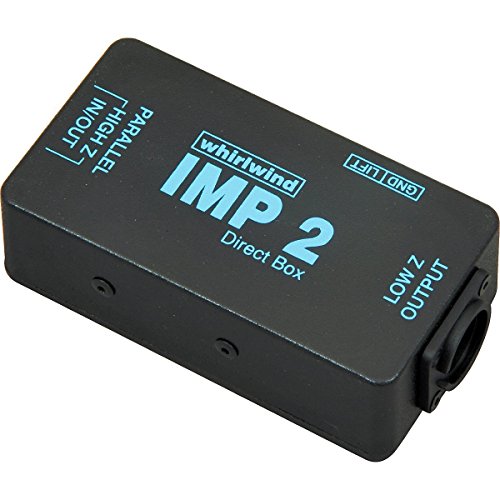
- Passive single-channel transformer DI
- Compact 8.8-ounce design
- Riveted TRHL transformer
Best For: Affordable mono instrument or line-level conversion
Eight-Channel Value

- Eight channels for multi-source setups
- Mains or phantom-powered operation
- Ultra-flat servo-balanced response
Best For: Studios, film sets, and live events needing multiple DI channels
Passive Stereo Pick

- Passive design needs no power
- Stereo input with summed mono output
- MIDAS transformer and high headroom
Best For: Stereo playback sources and simple passive setups
Flexible Active Control
ART DualXDirect Dual Active DI Box

- Phantom or 9V battery powered
- Dual-channel active design
- Switchable attenuation, filter, and phase
Best For: Dual-channel rigs needing adjustable signal control
Compact Hum Control

- Connects instruments and unbalanced line sources
- Provides buzz and hum cancellation
- Compact single-channel passive design
Best For: Portable guitar, bass, keyboard, and home-recording setups
Multi-Channel Routing

- Includes four fully isolated passive channels
- Offers three attenuation settings
- Routes a source to an amp and mixer
Best For: Multi-source live sound and rack-based setups
Dual-Channel Utility
Pyle-Pro PDC22 Dual Passive DI Box
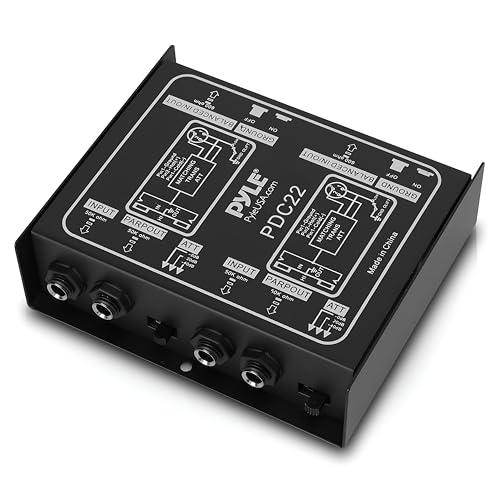
- Provides two passive DI channels
- Uses an all-steel chassis
- Supports instruments and line-level sources
Best For: Small live rigs needing durable two-channel connectivity
Rugged Passive Pick – Radial Pro DI
The Radial Pro DI is a durable passive option for shoppers comparing DI boxes under 200. Its transformer-based design, stainless-steel enclosure, and straightforward mono signal path suit both live and studio setups.
Best For: Acoustic guitar, bass, keyboards, drum machines, and professional snake or console systems.
Pros:
- Passive mono operation requires no separate power source.
- Custom transformer and rugged I-beam construction.
- XLR connectivity and support for live or studio use.
- Includes a 2-year warranty.
Cons:
- Mono design is less suitable for stereo keyboard or DJ rigs.
- Its passive format may not fit setups specifically needing an active DI.
The Radial Pro DI emphasizes dependable construction and broad instrument compatibility. Choose it when a rugged mono passive DI is more important than stereo operation or active circuitry.
Stereo Hum-Fighting Choice – Mackie MDB-2P
The Mackie MDB-2P is a practical choice among DI boxes under 200 for stereo sources. Dual 1/4-inch inputs, ground lift, and switchable 15 dB pads make it well suited to keyboards, DJ controllers, and backing-track rigs.
Best For: Stereo keyboards, DJ rigs, and backing-track setups that need hum reduction and hot-signal handling.
Pros:
- Dual 1/4-inch inputs support stereo sources.
- Ground lift helps address ground-loop buzz.
- 15 dB pads handle hotter signals without distortion.
- Passive design needs no power and uses a roadworthy steel case.
Cons:
- Its two-channel format may be unnecessary for a simple mono instrument.
- The supplied notes do not specify a warranty length beyond one year.
For stereo rigs, the MDB-2P offers useful problem-solving features in one compact passive box. It is especially appealing when hum control and input flexibility are priorities.
Flexible Active Option – Samson MDA1
The Samson MDA1 is an active direct box to consider when comparing DI boxes under 200. It combines a durable all-metal body with selectable attenuation, ground lift, and two power options for guitar and bass applications.
Best For: Guitar and bass setups that need active operation, attenuation control, and balanced XLR output.
Pros:
- Accepts 48V phantom power or a 9V battery.
- 0 dB/-15 dB attenuation switch helps manage signal levels.
- Ground lift and 1/4-inch input-through connections add setup flexibility.
- All-metal, impact-resistant steel design.
Cons:
- Requires phantom power or a 9V battery for operation.
- Listed as a mono direct box, so it is not intended for stereo sources.
The MDA1 is a sensible fit for players who want active DI features without giving up rugged construction. Its dual power options are useful when phantom power availability varies between venues.
Economical Workhorse – Whirlwind IMP 2
The Whirlwind IMP 2 is a straightforward value pick for shoppers seeking DI boxes under 200. Its passive transformer converts an unbalanced line- or instrument-level signal to a low-impedance balanced microphone-level output in a compact enclosure.
Best For: Musicians and live setups needing an inexpensive, durable mono DI for instrument or line-level signals.
Pros:
- Passive transformer operation requires no separate power.
- Converts unbalanced instrument or line signals to balanced mic level.
- Compact footprint and lightweight 8.8-ounce design.
- TRHL transformer is riveted to the chassis rather than glued.
Cons:
- Single-channel design is not suited to stereo sources.
- The supplied notes do not mention ground lift, attenuation, or a warranty.
The IMP 2 focuses on essential DI functionality, portability, and economical durability. It is a good match when you want a simple passive interface rather than extra controls or active circuitry.
Eight-Channel Value – Behringer DI800 V2
If you need multiple inputs in one rack-friendly direct box under 200, the Behringer DI800 V2 is built for larger setups. It provides impedance and signal matching for connecting instruments directly to mixers and amplifiers, with eight channels and XLR, TRS, and TS connectivity.
Best For: Recording studios, film sets, and live events requiring eight direct-box channels.
Pros:
- Eight-channel design supports larger audio setups.
- Can operate from mains power or phantom power.
- Servo-balanced operation provides an ultra-flat frequency response.
- Offers XLR and 1/4-inch interfaces.
Cons:
- Its five-pound weight may be more than needed for a small, portable rig.
- The supplied notes do not specify a battery-powered option.
The DI800 V2 stands out when channel count matters more than minimal size. Its flexible power options and broad connector support make it a practical choice for multi-source installations and performance systems.
Passive Stereo Pick – Klark Teknik PRO DI DI 10P
For shoppers comparing DI boxes under 200, the Klark Teknik PRO DI DI 10P offers a straightforward passive design with stereo inputs and summed mono output. Its 1/8-inch TRS and RCA inputs make it especially suitable for stereo playback sources.
Best For: Stereo instruments or playback devices that need a passive DI solution without a power supply.
Pros:
- Passive operation requires no power supply.
- Stereo input can be summed to a mono output.
- Uses a custom-built MIDAS transformer for signal integrity.
- High-headroom design supports strong signal handling.
Cons:
- It has fewer documented connectivity options than the other listed models.
- Passive operation does not provide the active features of a powered DI box.
With its compact 1.04-pound enclosure and stereo-focused layout, the DI 10P is a practical choice when simplicity and transformer-based passive operation are the priorities.
Flexible Active Control – ART DualXDirect Dual Active DI Box
If you are shopping for DI boxes under 200 and want more control over input levels, the ART DualXDirect combines active operation with two output channels. It accepts high-impedance balanced or unbalanced inputs and converts them to 600-ohm balanced outputs.
Best For: Performers and engineers who need dual-channel active DI performance with adjustable input handling.
Pros:
- Fully active design runs on phantom voltage or a 9V battery.
- Two output channels support dual-channel setups.
- Switchable attenuation offers 0, -20, and -40 dB settings.
- Includes a low-pass filter and phase-invert switch.
Cons:
- Battery operation requires a 9V battery when phantom power is unavailable.
- Its feature set may be more than needed for a basic single-channel application.
The DualXDirect is the most adjustable option in this group. Its dual-channel format, selectable attenuation, filtering, and phase controls make it useful for setups that benefit from active signal management.
Compact Hum Control – Pyle Premium Passive DI Box
If you are comparing DI boxes under 200 for a compact live or recording setup, the Pyle Premium Passive DI Unit offers a straightforward way to connect unbalanced sources to balanced XLR equipment. Its 1/4-inch connector, input attenuation, and hum-cancellation features suit guitars, basses, keyboards, and other line-level devices.
Best For: Musicians and home-recording users who need a compact passive DI box with ground-lift-style hum reduction and flexible source compatibility.
Pros:
- Connects guitars, basses, keyboards, effects processors, and other unbalanced sources.
- Helps reduce buzz and hum when feeding a PA or recording mixer.
- Includes input attenuation and supports balanced and unbalanced XLR connections.
- Compact design measures approximately 1.8 x 3.3 x 5 inches.
Cons:
- It is a single passive DI unit rather than a multi-channel option.
- The supplied notes do not specify detailed attenuation ranges or frequency-response figures.
This Pyle model is a practical choice when portability and basic hum control matter more than multiple channels. It can also handle consumer stereo or boom-box line outputs for sampling applications.
Multi-Channel Routing – ART PDB4 Four-Channel DI Box
For shoppers evaluating DI boxes under 200 for larger setups, the ART PDB4 stands out with four fully isolated passive channels. Switchable 0dB, -20dB, and -40dB input attenuation adds flexibility for managing different source levels while routing a music source to an amplifier and mixer at the same time.
Best For: Live rigs, installations, and recording setups that need four isolated DI channels and adjustable input attenuation.
Pros:
- Provides four fully isolated passive DI channels.
- Offers switchable 0dB, -20dB, and -40dB input attenuation.
- Can connect a music source to an instrument amplifier while also patching it to a mixer.
- Rack-style dimensions suit organized multi-channel setups.
Cons:
- At 2.2 pounds, it is less portable than a small single-channel DI box.
- The supplied notes do not list included cables or detailed connector specifications.
The PDB4 is the most suitable option here when channel count is the priority. Its isolated channels and selectable attenuation make it more adaptable for group or multi-source applications than a basic one-channel unit.
Dual-Channel Utility – Pyle-Pro PDC22 Dual Passive DI Box
If you need DI boxes under 200 for a two-source setup, the Pyle-Pro PDC22 provides two passive channels in an all-steel chassis. It is designed to connect guitars, basses, keyboards, effects processors, and other unbalanced sources to a PA or recording mixer while helping reduce buzz and hum.
Best For: Musicians and small live rigs that need two channels in a sturdy, uncomplicated passive direct box.
Pros:
- Provides two channels for handling multiple instruments or sources.
- All-steel chassis is built for durable use.
- Supports guitars, basses, keyboards, effects processors, and consumer line outputs.
- Includes hum-cancellation functionality for connecting unbalanced devices.
Cons:
- Its dual-channel format is less extensive than a four-channel DI unit.
- The supplied notes do not specify the available attenuation settings or detailed output connectors.
The PDC22 is a sensible middle ground between a compact single-channel box and a larger multi-channel unit. Choose it when two-channel capacity and a steel enclosure are more useful than rack-oriented expansion.
How We Picked the Best Di Boxes Under 200
We focused on direct boxes that solve common stage and recording problems without exceeding a $200 budget. The selection includes passive and active designs, mono and stereo options, single-channel units, and multi-channel models. We also considered transformer isolation, ground-lift controls, input flexibility, attenuation options, output layout, and likely use cases.
Because a DI box is part of your signal chain, practical reliability matters as much as the feature list. Models with straightforward controls, sturdy construction, and widely useful connections earned priority over units built around niche features.
Quick Comparison
| Best For | What to Look For | Recommended Type |
|---|---|---|
| Passive guitar or bass | Transformer isolation and ground lift | Passive mono DI |
| Keyboards and stereo sources | Two inputs or stereo operation | Passive stereo DI |
| Low-output instruments | Powered circuitry and strong headroom | Active DI |
| Multiple instruments | Several independent channels | Four-channel DI |
| Budget backup or compact rigs | Simple signal conversion and attenuation | Basic passive DI |
Key Buying Factors for DI Boxes Under $200
Active Vs. Passive Design
Passive DI boxes are usually simple, rugged, and well suited to active instruments or high-output sources. Active models can better accommodate passive pickups and weaker signals, but they typically require phantom power, a battery, or an external supply.
Channel Count and Signal Format
A mono DI is enough for a guitar, bass, or single microphone-level feed. Keyboards, mixers, playback devices, and stereo effects may need two channels or a stereo input with summed-mono capability. If several instruments must connect at once, a four-channel unit can reduce clutter and equipment changes.
Ground Lift and Isolation
Ground loops can create persistent hum and buzz. Transformer isolation and a ground-lift switch are valuable features for live rigs, interfaces, amplifiers, and interconnected powered equipment. They do not fix every noise problem, but they are among the most useful tools a DI can provide.
Inputs, Outputs, and Attenuation
Check whether the unit accepts 1/4-inch inputs, offers a through output for an amplifier, and provides enough attenuation for hot keyboard, preamp, or mixer signals. Balanced XLR outputs are important when sending the signal to a mixing console or stage box over long cable runs.
Who Should Buy Which Di Boxes Under 200?
Choose a passive mono model if you want a durable, uncomplicated solution for bass, guitar, or another powered instrument. An active DI is the better match for passive pickups, quieter sources, and setups where added signal flexibility matters. Keyboard players and electronic musicians should prioritize stereo inputs or dual channels, while bands, venues, and small production systems may benefit most from a multi-channel unit.
For occasional recording or a backup kit, a compact budget model can be sufficient. For frequent touring, prioritize robust construction, dependable isolation, and controls that are easy to reach in low-light conditions. Before buying, confirm your source output, power requirements, channel needs, and available console connections.