A dependable direct box can turn an instrument’s unbalanced output into a cleaner, balanced signal that travels confidently to the mixing console. The right model can also help reduce hum, match impedance, and simplify stage connections.
Our roundup covers 10 DI boxes for live sound, from compact passive units for guitar and bass to active, stereo, and multi-channel designs for more demanding setups.
Best 10 Di Boxes for Live Sound Picks for 2026
Reliable Passive Choice
Radial Pro DI Passive Direct Box

- Passive mono design with transformer isolation
- Rugged I-beam and stainless-steel construction
- Works with guitars, bass, keyboards, and drum machines
Best For: Durable mono instrument connections to live or studio consoles
Flexible Stereo Power

- Dual 1/4-inch inputs support stereo or mono use
- Dual thru and stereo XLR outputs
- USB Type-C or 9V battery power options
Best For: Stereo instruments and flexible live signal routing
Attenuation and Lift Control
Livewire SPDI Passive Direct Box

- High-impedance 1/4-inch input and throughput
- Balanced floating low-impedance XLR output
- Variable attenuation and ground-lift modes
Best For: Passive live rigs needing level and ground-connection control
Four-Channel Rack Solution
dbx DI4 Active 4-Channel Direct Box

- Four independent DI channels in a half-rack package
- Per-channel 20 dB pads and ground lifts
- Volume and pan controls for line mixer output
Best For: Multi-source stages and compact rack-based live systems
Simple Hum Control

- 1/4-inch input for instruments and line sources
- Ground-lift function helps reduce hum
- Connects to balanced or unbalanced XLR equipment
Best For: Basic instrument and line-source connections in live or recording setups
Best for Everyday Use
Bolanle J22 Active Stereo DI Box

- Dual channels retain stereo separation
- Supports phantom, battery, and USB power
- Ground lift and polarity reversal aid signal control
Best For: Stereo keyboards and instruments across varied live and studio setups
Road-Ready Isolation
Donner Special-I Passive DI Box

- Transformer isolation helps reduce hum and buzz
- Thru output feeds an amp alongside the PA
- Converts unbalanced signals to balanced mic level
Best For: Guitar, bass, and keyboard rigs needing amp-through routing
Flexible Two-Channel Value
Pyle-Pro PDC22 Dual Passive DI Box
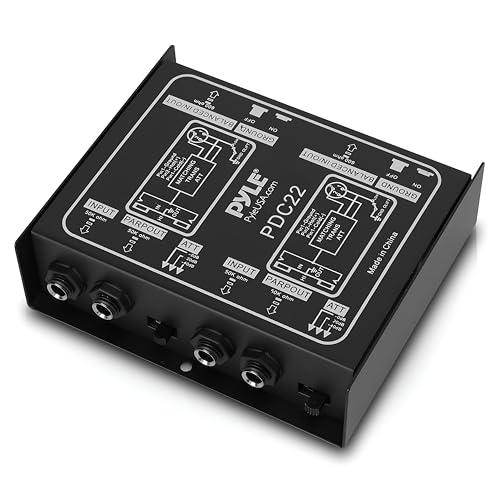
- Dual-channel design for multiple sources
- Ground lift helps address hum
- Steel chassis for regular gig use
Best For: Basic instrument and consumer-audio connections
Adjustable Noise Control
Bolanle DB2 Passive 2-Channel DI Box

- Three attenuation settings manage signal levels
- Ground lift targets ground-loop hum
- Balanced XLR outputs suit longer runs
Best For: Stereo instruments and flexible live/studio routing
Feature-Rich Dual Channel
StudioMan DI-2 Dual Channel Passive DI Box

- Two isolated channels with independent ground switches
- -30 dB pad helps manage hot signals
- Balanced XLR/TRS connectivity and detailed specs
Best For: Live bands, streaming, and multichannel recording
Reliable Passive Choice – Radial Pro DI Passive Direct Box
For musicians comparing DI boxes for live sound, the Radial Pro DI is a straightforward passive option for sending instrument signals to professional snake systems and consoles. Its transformer-based design, rugged I-beam construction, and XLR connectivity suit acoustic guitar, bass, keyboards, and drum machines in live or studio settings.
Best For: Players and engineers who want a durable passive DI for common instruments and professional console or snake connections.
Pros:
- Passive mono direct box with a built-in transformer.
- Rugged I-beam construction and stainless-steel enclosure.
- Suitable for acoustic guitars, bass, keyboards, and drum machines.
- Includes XLR connectivity and a 2-year warranty.
Cons:
- Mono operation limits stereo source applications.
- Passive design requires a suitable source and system setup.
The Radial Pro DI focuses on dependable construction and simple mono signal routing. It is a practical fit when durability and conventional XLR output matter more than extra controls or stereo operation.
Flexible Stereo Power – Dual-Input Active Direct Box
This active direct box offers dual 1/4-inch high-impedance inputs for stereo operation or mixed mono use, making it a flexible choice among DI boxes for live sound. It provides dual thru and XLR outputs, ground-lift support, and two power options for instruments, keyboards, submixers, and other unbalanced sources.
Best For: Performers and small live rigs needing stereo inputs, multiple outputs, and flexible power options.
Pros:
- Supports dual stereo inputs or mixed mono input operation.
- Provides dual 1/4-inch thru outputs and stereo XLR outputs.
- Can use USB Type-C charging or a 9V GF22 battery.
- Ground-lift function helps address buzz and hum in compatible setups.
Cons:
- The 9V battery is not included.
- Its larger, heavier design may be less convenient for minimal pedalboard setups.
- Power management adds more setup considerations than a passive DI.
With stereo support and flexible powering, this active DI is suited to more involved signal chains. Check your cable, power, and output requirements before relying on it for a specific stage setup.
Attenuation and Lift Control – Livewire SPDI Passive Direct Box
The Livewire SPDI is a compact passive option for musicians and engineers choosing DI boxes for live sound. It combines a high-impedance 1/4-inch input and throughput with a balanced, floating low-impedance XLR output, while variable attenuation and ground-lift controls help accommodate different signal levels and connection conditions.
Best For: Live setups that need passive signal conversion, input attenuation, and selectable ground connection control.
Pros:
- Includes 1/4-inch high-impedance input and throughput.
- Offers a balanced, floating low-impedance XLR output.
- Variable attenuation supports a range of input levels.
- Lift mode can sever the ground connection between input and XLR output.
Cons:
- Passive operation may not suit every source or system.
- The supplied notes do not specify a warranty or included accessories.
The SPDI keeps the feature set focused on practical live routing: throughput, balanced XLR output, attenuation, and ground control. It is worth considering when those controls are more important than active circuitry or extensive channel features.
Four-Channel Rack Solution – dbx DI4 Active 4-Channel Direct Box
For larger stages and installations, the dbx DI4 provides four independent active DI channels in a half-rack package. It is a strong multi-channel choice among DI boxes for live sound, with per-channel pads and ground lifts plus volume and pan controls for its line mixer output.
Best For: Bands, venues, and engineers needing four independent DI channels with centralized rack-style control.
Pros:
- Combines four independent DI units in a 1/2 RU package.
- Provides an independent 20 dB pad and ground lift for each channel.
- Includes per-channel volume and pan controls for line mixer output.
- Accepts 1/4-inch jack and RCA inputs with XLR outputs.
Cons:
- Requires corded electric power.
- A four-channel rack-style unit may be excessive for a single instrument.
- The supplied specifications list a 20 Hz frequency figure but do not provide a full frequency-response range.
The DI4 is designed around channel density and independent control rather than portability for one-off instrument use. It makes the most sense when multiple sources need consistent DI treatment in a compact rack format.
Simple Hum Control – Pyle Premium Passive DI Box
For musicians comparing DI boxes for live sound, the Pyle PDC21 is a straightforward passive option for routing unbalanced instrument or line-level sources to balanced or unbalanced connections. Its 1/4-inch input, input attenuation, and ground-lift functionality make it useful for guitars, basses, keyboards, and other audio devices.
Best For: Players and small live setups needing basic impedance matching and hum reduction for instruments, keyboards, or consumer audio sources.
Pros:
- Connects 1/4-inch sources to balanced or unbalanced XLR equipment.
- Ground-lift design helps address buzz and hum.
- Supports guitars, basses, keyboards, processors, and line outputs.
Cons:
- Passive design may be less flexible than an actively powered DI box.
- Supplied notes do not specify stereo operation or multiple channels.
The PDC21 is a practical choice when you want a compact, uncomplicated way to connect common instruments and unbalanced sources to a PA or mixer while helping control ground-loop noise.
Best for Everyday Use – Bolanle J22 Active Stereo DI Box
Among DI boxes for live sound, the Bolanle J22 stands out for stereo operation and flexible power. It accepts two unbalanced 1/4-inch inputs and provides dual balanced XLR outputs, while 48V phantom power, a 9V battery, or 5V USB can keep it running in different stage and studio situations.
Best For: Keyboard players, synth users, and performers who need stereo routing, multiple power options, and ground-loop control.
Pros:
- Dual channels preserve stereo separation for keyboards and synths.
- Runs from 48V phantom power, a 9V battery, or 5V USB.
- Ground lift and polarity reversal provide additional signal control.
- Metal housing is designed for stage and touring use.
Cons:
- Batteries are not included.
- Its 2.03-pound weight is greater than many compact single-channel DI units.
The J22 is a versatile pick for performers who cannot rely on one power source or who need to send a true stereo signal to the front-of-house system. Its broad connectivity also suits rehearsals, churches, studios, and DJ setups.
Road-Ready Isolation – Donner Special-I Passive DI Box
The Donner Special-I is a passive choice for musicians seeking DI boxes for live sound with transformer isolation and a through output. It converts an unbalanced instrument or line signal to a low-impedance balanced microphone-level output, helping connect guitars, basses, and keyboards to a mixer or PA.
Best For: Stage and studio users who want a passive DI with ground-loop isolation, a ground lift, and an amp-through connection.
Pros:
- Transformer isolation helps reduce ground-loop hum and buzz.
- Ground lift supports quieter live and studio connections.
- Thru output lets you feed an amplifier while sending the balanced signal to the PA.
- Designed for guitars, basses, keyboards, and other instrument-level sources.
Cons:
- Passive design does not provide the multiple power options of an active DI.
- Supplied notes describe a single DI unit rather than stereo operation.
With its transformer-based isolation and amp-through routing, the Special-I is well suited to conventional stage rigs where an instrument needs to reach both an amplifier and the mixing console without adding a powered device.
Flexible Two-Channel Value – Pyle-Pro PDC22 Dual Passive DI Box
The Pyle-Pro PDC22 is a straightforward option for musicians who need practical DI boxes for live sound. Its two channels, 1/4-inch connections, ground-lift capability, and steel chassis make it suitable for routing instruments or other unbalanced sources to a PA or recording mixer.
Best For: Musicians and small live setups connecting guitars, basses, keyboards, or consumer audio devices to a mixer.
Pros:
- Two channels support multiple instruments or sources.
- Ground-lift and hum-cancellation features help reduce unwanted noise.
- Steel construction is suited to regular handling.
- Works with instruments, processors, boom boxes, and consumer stereo outputs.
Cons:
- Its supplied notes do not specify detailed audio performance measurements.
- The design is passive, so it may offer fewer controls than an active DI.
The PDC22 emphasizes broad compatibility and simple operation rather than extensive features. It is a sensible pick when you want a durable dual-channel box for basic live or recording connections.
Adjustable Noise Control – Bolanle DB2 Passive 2-Channel DI Box
The Bolanle DB2 is one of the more adaptable DI boxes for live sound, combining two passive channels with ground-lift and three-stage signal attenuation. It converts high-impedance instrument signals to balanced XLR output for live performance, studio mixing, or longer cable runs.
Best For: Guitarists, bassists, keyboard players, and audio engineers who need stereo operation and flexible level control.
Pros:
- Dual-channel configuration supports stereo or two separate sources.
- Ground lift is designed to reduce ground-loop hum and interference.
- Selectable 0 dB, -20 dB, and -40 dB attenuation helps accommodate different signal levels.
- Balanced XLR output supports long-distance transmission.
Cons:
- The supplied notes do not provide frequency-response or distortion specifications.
- As a passive unit, it may not provide the additional features of an active DI.
With its attenuation choices and balanced outputs, the DB2 offers useful control for varied instruments and signal environments. Its rust-resistant, scratch-resistant design also suits musicians who need a road-ready two-channel box.
Feature-Rich Dual Channel – StudioMan DI-2 Dual Channel Passive DI Box
The StudioMan DI-2 is designed for musicians and engineers comparing feature-rich DI boxes for live sound. It provides two isolated channels, 50KΩ inputs, balanced XLR/TRS connectivity, independent ground switches, and a -30 dB pad for handling instruments and higher-output sources.
Best For: Bands, streamers, and recording users connecting guitars, basses, keyboards, or synths to mixers, interfaces, or PA systems.
Pros:
- Independent channels can handle guitar/bass and keyboard/synth setups simultaneously.
- Separate ground switches provide channel-by-channel noise control.
- A -30 dB pad helps prevent clipping from high-output devices.
- Published specifications include 20 Hz–20 kHz response, THD+N below 0.03%, and over 85 dB channel isolation.
Cons:
- The -30 dB attenuation option is less adjustable than a multi-step pad.
- Its extra controls and connections may be more than needed for a simple setup.
The DI-2 stands out for its per-channel controls and detailed stated specifications. Its compact, driver-free design is practical for quick live setups, pedalboards, gig bags, and studio connections.
How We Picked These Di Boxes for Live Sound
We selected models across the main categories performers and engineers encounter on stage: passive single-channel boxes, active designs, stereo units, dual-channel options, and multi-input solutions. We considered connection flexibility, signal-conversion needs, grounding features, attenuation controls, power requirements, portability, and suitability for instruments such as guitar, bass, keyboards, playback devices, and electronic instruments.
Because live rigs vary widely, the list includes both straightforward budget solutions and more expandable designs. Product specifications and stated features were weighed alongside practical setup considerations, rather than assuming one type of DI box is best for every performer.
Quick Comparison
| Need | Best type to consider | Why |
|---|---|---|
| Simple guitar or bass connection | Passive single-channel DI | Easy to use, compact, and requires no battery or phantom power |
| Low-output or passive instruments | Active DI | Can provide higher input impedance and more signal flexibility |
| Keyboard or stereo playback | Stereo or dual-channel DI | Keeps left and right channels organized |
| Several sources at once | Multi-channel DI | Reduces rack and stage clutter |
| Ground-loop problems | DI with ground lift | May help isolate unwanted hum in compatible setups |
Key Buying Factors for Di Boxes for Live Sound
Passive or Active Design
Passive DI boxes are generally simple, durable, and convenient when the source has a healthy output level. Active models may be preferable for passive basses, piezo pickups, and other sources that benefit from higher input impedance or additional headroom. Active units typically need a battery, phantom power, or another power source.
Channel Count and Stereo Support
A single-channel box is sufficient for many guitars and basses. Choose a dual-channel or stereo model for keyboards, stereo effects, DJ equipment, or two independent instruments. A four-channel unit can be more practical for bands, installations, and compact live rigs with multiple line-level sources.
Connections and Controls
Check for the input and output formats your system uses, including 1/4-inch instrument inputs, XLR balanced outputs, link or through outputs, and any TRS support. Ground-lift switches can be valuable when hum occurs, while input attenuation pads help accommodate hotter signals. If you need to send a signal back to an amplifier or pedal chain, verify that the model specifically supports reamping or the required routing.
Build and Stage Practicality
Look for a sturdy enclosure, clearly labeled controls, accessible switches, and a layout that will not invite accidental changes during a performance. Compact dimensions matter for pedalboards and travel, but larger units may offer better access and more channels.
Who Should Buy Which Di Boxes for Live Sound?
Guitarists and bassists seeking a dependable, no-fuss connection should start with a passive single-channel model. Players using passive pickups, piezo systems, or quieter sources should consider an active DI, provided power is available. Keyboardists and electronic musicians will usually benefit from stereo or dual-channel connectivity. Bands, houses of worship, theaters, and small production teams may get more value from a multi-channel unit that reduces the number of separate boxes required.
Before buying, confirm the source output, mixer inputs, channel requirements, and available power. A well-matched DI box should solve a specific signal-routing problem without adding unnecessary controls or complexity.