Live keyboards need a clean, balanced path to the PA, especially when stereo effects, long cable runs, and multiple instruments share the stage. The right DI box can reduce hum, preserve your keyboard’s sound, and make front-of-house setup more predictable.
We selected 10 DI options spanning passive and active designs, stereo and mono configurations, USB-equipped models, and professional transformer-based units. Use the guide below to match features and power requirements to your rig.
Best 10 Di Boxes for Live Keyboards Picks for 2026
Best Stereo Keyboard Pick

- Dual 1/4-inch inputs for stereo sources
- 15 dB pads handle hot signals
- Passive, power-free design with ground lift
Best For: Stereo keyboards, DJ rigs, and backing-track setups
Best Flexible Signal Routing

- Balanced XLR output from 1/4-inch input
- -15 dB and -30 dB pad settings
- Thru output supports amplifier monitoring
Best For: Single keyboard channels needing FOH and amp connections
Best Feature-Rich Stereo Value

- Dual channels for stereo keyboards
- Per-channel pads and thru outputs
- Ground lift and polarity reversal controls
Best For: Stereo synths and live rigs needing phase and monitoring control
Best Rugged Mono Choice
Radial Pro DI Passive Direct Box

- Passive mono design with custom transformer
- Rugged I-beam construction
- Two-year warranty for live or studio use
Best For: Mono keyboards and professional live or studio signal chains
Best USB-Ready DI Box
StudioMan MOB-2 Active USB Audio DI Box

- Stereo active DI with balanced dual XLR outputs
- Plug-and-play USB-C audio interface functionality
- Bluetooth streaming and ground-lift switch
Best For: Keyboard players needing stereo DI, USB, and wireless features
Best Premium Passive DI
Radial JDI Jensen-equipped Direct Box
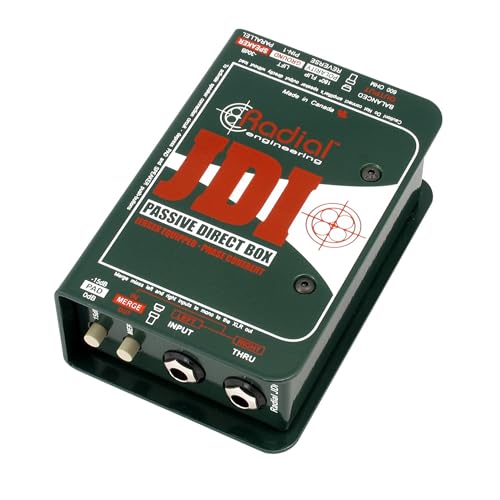
- Jensen transformer for ground-loop isolation
- Virtually zero phase and harmonic distortion
- Durable stainless-steel enclosure
Best For: Single-channel setups prioritizing passive transformer isolation
Best Battery-Powered Stereo DI
Active Stereo Direct Box with Dual 1/4-Inch Inputs

- Dual inputs handle stereo or mixed mono signals
- Stereo XLR and 1/4-inch thru outputs
- Type-C charging or 9V battery operation
Best For: Portable stereo keyboard rigs with flexible power needs
Transformer-Isolated Pick

- High-impedance passive transformer design
- Helps eliminate ground-loop noise
- Includes Pig Hog mic cable
Best For: Simple, dependable keyboard and instrument setups
Best Heavy-Duty Pick

- Two channels maintain left/right separation
- Supports phantom, battery, or USB power
- Ground lift helps reduce stage hum
Best For: Stereo keyboards and dual-output synths
Budget Routing Pick

- Balanced XLR conversion for live sound
- Ground lift helps address hum
- Attenuation switch aids level matching
Best For: Basic PA, club, monitor, and DJ routing
Best Stereo Keyboard Pick – Mackie MDB-2P
For players comparing DI boxes for live keyboards, the Mackie MDB-2P is a practical stereo option with dual 1/4-inch inputs, passive operation, and controls aimed at common stage problems. Its ground lift helps address hum, while the 15 dB pads provide extra headroom for hot keyboard or DJ signals.
Best For: Stereo keyboards, DJ rigs, and backing-track setups that need a simple, power-free DI.
Pros:
- Dual high-impedance 1/4-inch inputs support stereo sources.
- 15 dB pads help manage hot signals without distortion.
- Ground lift can reduce ground-loop buzz.
- Passive design requires no power, and the steel case is roadworthy.
Cons:
- It is a passive stereo DI rather than an active design.
- The supplied notes do not list a thru output for amplifier monitoring.
The MDB-2P is a straightforward choice when stereo connectivity and reliable hum control matter more than extra routing features. Its no-power design also keeps setup simple for touring and rehearsal use.
Best Flexible Signal Routing – Samson MD1 Pro
The Samson MD1 Pro is a versatile option among DI boxes for live keyboards, converting a 1/4-inch unbalanced source to a balanced mic-level XLR output. Its passive signal path, switchable attenuation, ground lift, and thru output make it useful for both front-of-house and stage-monitoring connections.
Best For: Live keyboardists and studios that need balanced XLR output plus a parallel thru connection.
Pros:
- Accepts instrument- or line-level 1/4-inch signals and provides balanced XLR output.
- Two-stage -15 dB/-30 dB pad accommodates hotter sources.
- Ground lift helps combat hum and buzz.
- Passive thru output can feed an amplifier or other stage device.
Cons:
- It is a single-channel DI, so stereo keyboards require two units.
- The supplied notes do not specify a dedicated keyboard stereo configuration.
Choose the MD1 Pro when flexible routing is a priority. The thru output is especially useful when a keyboard signal must reach both the mixer and a local amplifier, while the steel chassis suits stage and studio work.
Best Feature-Rich Stereo Value – Bolanle D2 Premium Stereo DI
The Bolanle D2 combines two channels with independent -15 dB pads, thru outputs, and polarity reversal, making it a feature-rich choice among DI boxes for live keyboards. It is designed for stereo synths and keyboards while also addressing hum, phase, and monitoring needs in one compact metal enclosure.
Best For: Stereo keyboards, dual-output synthesizers, and live setups requiring phase control and thru routing.
Pros:
- Two independent channels handle stereo instruments or two separate sources.
- Per-channel -15 dB pads help prevent clipping from hot signals.
- Ground lift and polarity reversal address hum and phase issues.
- Each channel includes a 1/4-inch thru output for local amp monitoring.
Cons:
- The supplied notes do not provide detailed frequency-response or transformer specifications.
- At 1.94 pounds, it is heavier than some compact DI options.
The D2 stands out for live stereo rigs that need more than basic XLR conversion. Its combination of dual channels, per-channel attenuation, polarity controls, and thru outputs offers useful flexibility for touring, church sound, and FOH work.
Best Rugged Mono Choice – Radial Pro DI Passive Direct Box
The Radial Pro DI is a rugged passive mono direct box for performers who want a durable signal path for a keyboard, drum machine, bass, or other instrument. Its custom transformer and I-beam construction make it a focused option when reliability and straightforward XLR integration are the priorities.
Best For: Mono keyboards and live or studio setups using professional snakes, consoles, or instrument inputs.
Pros:
- Passive mono design uses a custom transformer.
- Rugged I-beam construction is built for demanding use.
- Suitable for live or studio applications with keyboards and drum machines.
- Includes a two-year warranty.
Cons:
- Mono operation is not ideal for stereo keyboard outputs without a second DI.
- The supplied notes do not list a ground lift, pad, or thru output.
The Pro DI is a sensible pick for musicians who value a durable, uncomplicated mono DI. For stereo keyboards or unusually hot outputs, verify your routing and headroom requirements before choosing it.
Best USB-Ready DI Box – StudioMan MOB-2 Active USB Audio DI Box
For musicians comparing di boxes for live keyboards, the StudioMan MOB-2 stands out as a versatile active option with stereo operation, USB connectivity, and Bluetooth streaming. Its balanced XLR outputs and ground-lift switch make it practical for connecting keyboards and other sources to a PA or studio system.
Best For: Keyboard players and creators who want stereo DI functionality with USB and wireless audio options.
Pros:
- Supports stereo operation and connects to keyboards, guitars, and basses.
- USB-C plug-and-play connection requires no driver installation.
- Balanced left and right XLR outputs plus a ground-lift switch help manage connection noise.
- Includes Bluetooth audio streaming and a compact design.
Cons:
- Its extra USB and Bluetooth features may be unnecessary for a simple stage DI setup.
- Requires USB power or another suitable power arrangement for its active features.
The MOB-2 is a flexible choice when a live keyboard rig may also need recording, streaming, or wireless playback. Its stereo XLR outputs and ground lift keep the core live-sound functionality useful, while the added digital features broaden its applications.
Best Premium Passive DI – Radial JDI Jensen-equipped Direct Box
For players seeking straightforward di boxes for live keyboards, the Radial JDI is a focused passive solution built around a Jensen transformer. It is designed to address ground-loop buzz and hum while maintaining very low phase and harmonic distortion.
Best For: Keyboardists and live-sound setups that prioritize passive transformer isolation and clean signal conversion.
Pros:
- Jensen transformer helps eliminate buzz and hum from ground loops.
- Passive design offers a simple, dedicated signal path.
- Designed for virtually zero phase and harmonic distortion.
- Stainless-steel construction provides a durable enclosure.
Cons:
- Provides one channel, so stereo keyboards require two DI boxes or another stereo solution.
- Does not include the USB, Bluetooth, or active features found on some alternatives.
The JDI is best suited to buyers who want a purpose-built passive DI rather than a multifunction interface. Its single-channel format is a key consideration for stereo keyboard rigs, but the Jensen transformer and low-distortion design make it a strong fit for clean, isolated connections.
Best Battery-Powered Stereo DI – Active Stereo Direct Box with Dual 1/4-Inch Inputs
This active direct box is a practical contender among di boxes for live keyboards, especially when stereo connections and flexible power options matter. Dual high-impedance 1/4-inch inputs can accept stereo or mixed mono signals, with both thru and XLR stereo outputs for stage and mixer connections.
Best For: Keyboard players who need stereo I/O, ground-lift noise control, and portable Type-C or 9V battery power.
Pros:
- Dual 1/4-inch inputs support stereo or mixed mono signals.
- Provides dual 1/4-inch thru outputs and stereo XLR outputs.
- Offers Type-C charging or a built-in 9V battery slot.
- Ground-lift functionality helps address buzz and hum with keyboards and other unbalanced sources.
Cons:
- 9V battery is not included.
- The supplied notes identify it primarily as an active DI for instruments and do not specify detailed audio-performance measurements.
With stereo routing, thru connections, and two power methods, this direct box fits flexible live keyboard setups. Buyers should plan for the separate battery purchase if they intend to use battery power, while Type-C charging offers an alternative for compatible setups.
Transformer-Isolated Pick – Radial ProDI Bundle
For players comparing DI boxes for live keyboards, the Radial Engineering ProDI Bundle is a straightforward passive option with a custom-wound transformer, high input impedance, and a transformer-isolated output. It also includes a Pig Hog mic cable and polishing cloth for a convenient gig-ready package.
Best For: Keyboard players and musicians who want a simple, passive DI with strong signal handling and ground-loop isolation.
Pros:
- 140kΩ input impedance is designed to handle extreme signal levels without distortion across frequencies.
- Transformer-isolated output helps reduce ground-loop noise.
- Plug-and-play operation requires no complex setup.
- Bundle includes a Pig Hog mic cable and Liquid Audio polishing cloth.
Cons:
- Passive design does not offer the three power options or dual-channel stereo routing of the J22.
- The supplied notes do not specify dual-channel operation.
The ProDI is a practical choice when reliability, simple operation, and transformer isolation matter more than extra routing or power features. Its included cable adds value for live players building a compact setup.
Best Heavy-Duty Pick – Bolanle J22 Active Stereo DI
Among DI boxes for live keyboards, the Bolanle J22 stands out for its dual-channel stereo routing and flexible power options. It accepts two 1/4-inch inputs and sends separate left/right signals through balanced XLR outputs, making it suited to stereo keyboards and dual-output synths.
Best For: Keyboard players who need stereo separation, multiple power options, and ground-loop control in one compact DI box.
Pros:
- Dual channels preserve stereo separation through two XLR outputs.
- Runs from 48V phantom power, a 9V battery, or 5V USB power.
- Ground lift switch helps reduce hum from ground loops and shared power systems.
- Metal housing, polarity reversal, and compact dimensions support live use.
Cons:
- Batteries are not included.
- Its active design requires access to one of the listed power sources.
The J22 is the most feature-rich choice here for stereo keyboard rigs. Its power flexibility is especially useful for stages, rehearsals, and setups where phantom power may not be available.
Budget Routing Pick – Passive Two-Input DI Box
For shoppers seeking basic DI boxes for live keyboards, this passive two-input model focuses on signal conversion, level matching, and noise reduction. It converts high-impedance unbalanced signals to low-impedance balanced XLR outputs and includes both a ground-lift switch and attenuation control.
Best For: Live sound, PA, club, monitor, and DJ setups needing a rugged passive DI with practical level and noise controls.
Pros:
- Converts unbalanced instrument signals to balanced XLR output for audio transmission.
- Ground lift can reduce hum caused by multiple connected devices.
- Attenuation switch supports level matching with connected equipment.
- High-strength housing is designed for steady, long-term use.
Cons:
- The supplied notes do not specify stereo-separated outputs.
- No power options or included accessories are listed.
This is a functional choice for straightforward live routing when you need passive conversion, attenuation, and ground-lift control without adding a powered feature set. Confirm the input and output arrangement fits your keyboard setup before buying.
How We Picked the Best Di Boxes for Live Keyboards
We focused on the needs of keyboard players performing through venue or touring PA systems: balanced XLR outputs, dependable noise control, suitable headroom, practical input options, and easy stage operation. Stereo capability received special attention because many keyboards use stereo piano, organ, pad, delay, and modulation effects. We also considered whether each design offers passive simplicity, active gain flexibility, ground-lift control, padding, merging, or alternative power sources.
Build quality and reputation matter onstage, so established professional DI designs are represented alongside more feature-rich and budget-oriented alternatives. A DI box should be judged by how well it fits the complete signal chain, not by the number of switches on its front panel.
Quick Comparison
- Best for straightforward stereo setups: Choose a passive stereo DI with dual inputs and ground lift.
- Best for high-impedance or lower-output sources: Consider an active DI with phantom-power or battery support.
- Best for demanding professional rigs: Transformer-isolated models from established stage-audio brands are strong long-term choices.
- Best for flexible home and live use: A USB-equipped DI can combine direct injection with basic computer connectivity.
- Best for compact mono rigs: A single-channel passive DI is simple, durable, and easy to troubleshoot.
Key Buying Factors for Di Boxes for Live Keyboards
Stereo or Mono Output
Use a stereo DI when the keyboard’s effects or instrument patches depend on left-right imaging. A mono DI can work for a centered mix, but summing stereo outputs may change the sound of certain patches. Confirm whether the model provides two independent channels or a true stereo arrangement.
Active Versus Passive Circuitry
Passive boxes are usually simple, quiet, and do not require batteries or phantom power. Active models can better accommodate weak or high-impedance sources and may offer more control, but they need a reliable power source. Check whether phantom power is available from the mixing console and whether the DI supports battery or external power as a backup.
Ground Lift and Isolation
Ground loops can create hum when a keyboard, amplifier, mixer, and other powered devices are connected. Ground lift and transformer isolation can help break those loops, though they should be used correctly and are not substitutes for safe electrical practices.
Headroom, Pads, and Connectors
Keyboards can produce strong line-level signals, so look for adequate headroom and a pad if your mixer input clips. Dual 1/4-inch inputs are convenient for stereo keyboards, while balanced XLR outputs support long cable runs to the stage box. Check input impedance and through outputs if you also feed a keyboard amplifier or monitor system.
Who Should Buy Which Di Boxes for Live Keyboards?
Choose a passive stereo model if you want the least complicated solution for a typical powered keyboard. Pick an active stereo DI if your rig needs more input flexibility, extra gain handling, or multiple power options. A premium transformer-isolated unit is worth considering for touring, frequent venue changes, or persistent noise problems. Solo performers and hybrid setups may prefer a USB-capable model, while players running one mono keyboard output can save space and money with a single-channel passive box. Before buying, verify the output layout, power method, pad range, and whether the unit preserves the stereo signal you actually use.