The right equalizer can make vocals clearer, more controlled, and easier to place in a mix. This roundup covers 10 options ranging from beginner-friendly recording interfaces to dedicated graphic EQs for home audio, karaoke, DJ, and stage systems.
Because these products serve different workflows, consider whether you need microphone preamp and USB recording, precise rack-mount control, vocal effects, or simple stereo tone shaping before you buy.
Best 10 Audio Equalizers for Recording Vocals Picks for 2026
Best Entry-Level Interface
Focusrite Scarlett Solo 3rd Gen

- XLR mic preamp with 56dB gain range
- Air mode for added recording clarity
- 24-bit/192kHz recording support
Best For: Solo vocalists and home-recording beginners using software EQ
Best Hardware Vocal EQ
dbx 231s Dual Channel 31-Band Equalizer

- Dual 31-band, 1/3-octave EQ sections
- Switchable 6dB or 12dB boost/cut
- XLR and TRS inputs and outputs
Best For: Rack-based studios and live vocal signal chains
Best Feature-Rich Graphic EQ

- 31-band tuning with spectrum monitoring
- Custom modes and auto-save presets
- Optical, coaxial, USB, and Bluetooth connectivity
Best For: Flexible home, karaoke, studio, and live audio systems
Best Vocal Processing System
Digital Karaoke DSP Mixer with Vocal Effects

- 13-band microphone EQ tuning
- Vocal enhancement, echo, reverb, and key shifting
- Feedback suppression with multiple audio inputs
Best For: Karaoke, live vocals, hosting, and streaming
Rackmount Vocal Control
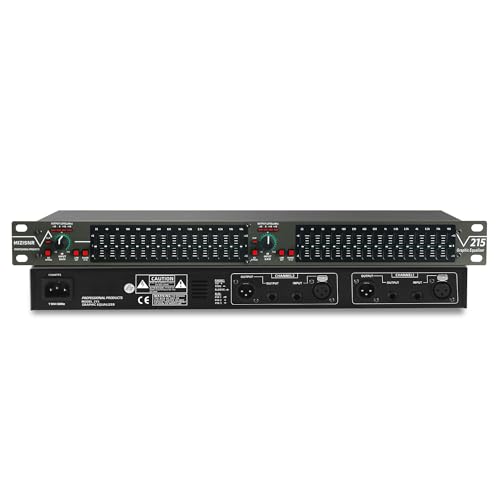
- 15 bands per channel with ±12dB adjustment
- Low-cut filter targets rumble, wind noise, and hum
- Balanced XLR plus unbalanced TRS connections
Best For: Rack-mounted home studios, live vocals, and installations
Compact Hi-Fi Shaping

- Nine bands span 20Hz to 16kHz
- 111dB SNR and 0.001% THD specifications
- RCA inputs and outputs with bypass and balance controls
Best For: Compact RCA-based home audio and monitoring systems
Visual Studio Processing
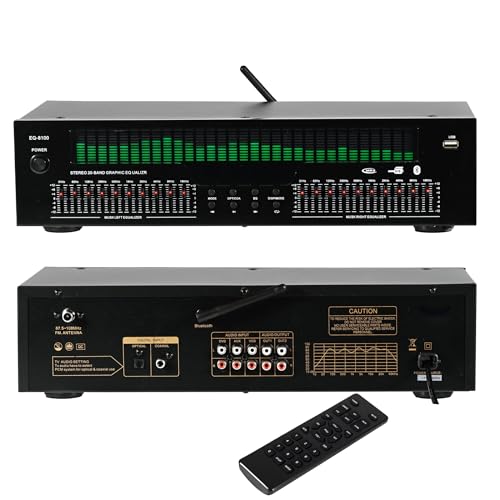
- 20-band EQ with 31-band real-time spectrum display
- Optical, coaxial, USB, Bluetooth, and RCA connectivity
- Auto-save presets and customizable modes
Best For: Studios and live setups needing visual analysis and flexible inputs
Best Analog Control

- 31 bands per channel with up to ±12 dB adjustment
- Low-cut filter helps reduce rumble and hum
- XLR and 1/4-inch TRS connectivity
Best For: Hands-on studio, live, and installed audio control
Best Feature-Rich Presets

- 10 preset modes with high, mid, and bass adjustment
- Real-time 31-segment LED spectrum display
- Bluetooth 5.2, USB playback, and noise reduction
Best For: Multi-purpose studio and DJ systems needing visual control
Best for Modern Connectivity

- 31-band DSP with four-color spectrum monitoring
- 10 presets, noise reduction, Bluetooth 5.2, and USB
- Adjustable 50–250 Hz independent subwoofer output
Best For: Versatile studio and live systems with digital playback
Best Entry-Level Interface – Focusrite Scarlett Solo 3rd Gen
The Focusrite Scarlett Solo 3rd Gen is an audio interface rather than a standalone equalizer, but it provides a clean starting point for using audio equalizers for recording vocals in compatible recording software. Its XLR microphone input, 56dB gain range, Air mode, and 24-bit/192kHz support suit simple vocal recording setups.
Best For: Solo vocalists, podcasters, and home-recording beginners who want a compact interface for software-based EQ.
Pros:
- Includes an XLR mic preamp with a 56dB gain range.
- Air mode can add extra clarity to compatible recordings.
- Supports recording and mixing up to 24-bit/192kHz.
- Includes recording software, effects, instruments, and mastering tools.
Cons:
- Does not provide dedicated onboard graphic EQ bands.
- Has only one XLR microphone input.
Choose the Scarlett Solo when you want to shape vocals with plug-ins inside a computer or compatible device. It is a practical recording front end, but users seeking hands-on hardware EQ will need a separate equalizer.
Best Hardware Vocal EQ – dbx 231s Dual Channel 31-Band Equalizer
The dbx 231s is a dedicated dual-channel equalizer for shaping vocal signals before amplification or recording. Its two 31-band, 1/3-octave constant-Q sections provide detailed hands-on control, making it a strong option for audio equalizers for recording vocals in rack-based setups.
Best For: Studios, live vocal rigs, and users who want physical dual-channel EQ controls.
Pros:
- Provides 31 bands per channel for detailed frequency adjustment.
- Offers switchable 6dB or 12dB boost/cut ranges.
- Includes front-panel bypass and output-level LED monitoring.
- Supports both 1/4-inch TRS and XLR inputs and outputs.
Cons:
- Its rack-style design is less convenient for compact desktop setups.
- Requires compatible external audio equipment and cabling.
The dbx 231s is the most direct match here for hands-on vocal equalization. Dual 31-band control is useful when you need precise shaping, though its rack format makes it better suited to an established signal chain than a minimal home setup.
Best Feature-Rich Graphic EQ – 31-Band Home Audio Equalizer
This 31-band digital graphic equalizer combines detailed frequency adjustment with spectrum monitoring, presets, noise reduction, and multiple digital connections. For users exploring audio equalizers for recording vocals, it may help refine vocal clarity, although the supplied notes position it as a broad home, studio, and live-audio processor rather than a dedicated vocal recording interface.
Best For: Multi-purpose home audio, karaoke, studio-monitor, and live setups needing flexible connectivity.
Pros:
- Offers 31-band tuning with real-time spectrum monitoring.
- Includes customizable modes and auto-save presets.
- Supports optical, coaxial, USB, and other system connections.
- Designed for home audio, recording studios, live stages, and KTV use.
Cons:
- Its broad entertainment focus may be more than a simple vocal setup needs.
- The supplied notes do not specify detailed recording-interface specifications.
This model is worth considering when vocal EQ is part of a larger audio system that also needs Bluetooth, USB, digital inputs, presets, and spectrum display. For straightforward computer recording, a dedicated interface and software EQ may be simpler.
Best Vocal Processing System – Digital Karaoke DSP Mixer with Vocal Effects
The Digital Karaoke Mixer Audio Processor System pairs DSP processing with vocal effects, feedback suppression, and 13-band EQ control. It is a practical choice for singers, hosts, and live-streaming users who want audio equalizers for recording vocals alongside echo, reverb, mic priority, and multiple source inputs.
Best For: Karaoke, live vocals, hosting, streaming, and systems that need vocal effects with EQ.
Pros:
- Provides 13-band EQ tuning for microphone signals.
- Includes vocal enhancement, echo, reverb, and key shifting.
- Offers one-touch feedback suppression and mic priority.
- Supports two microphone inputs plus Bluetooth, USB, optical, coaxial, and AUX sources.
Cons:
- Its karaoke-oriented feature set may be excessive for simple studio recording.
- It has fewer EQ bands than a 31-band graphic equalizer.
Choose this processor when vocal polish and feedback control matter as much as frequency shaping. Its LCD display, remote, DSP effects, and varied outputs make it especially suitable for performance-oriented setups rather than a bare recording chain.
Rackmount Vocal Control – 15-Band Stereo Graphic EQ
For anyone comparing audio equalizers for recording vocals, the EQ-215 offers hands-on control over two stereo channels. Its 15 bands per channel, low-cut filter, and balanced XLR connectivity make it suited to shaping vocal tone while reducing common low-frequency noise.
Best For: Home studios, live vocal setups, and rack-mounted audio systems that need detailed analog-style EQ control.
Pros:
- 15 adjustable bands per channel with up to ±12dB of range.
- Low-cut switch helps attenuate wind noise, floor rumble, and electrical hum.
- XLR balanced and 1/4-inch TRS unbalanced inputs and outputs support varied setups.
- Bypass switch and standard 1U rack-mount design simplify system testing and installation.
Cons:
- Its rackmount form factor may be more equipment than a small desktop recording setup needs.
- It is a graphic EQ rather than a digital processor with presets or visual spectrum analysis.
The EQ-215 is a practical choice when you want direct frequency-by-frequency adjustment and dedicated low-frequency cleanup. Its dual-channel rack design is especially useful for studio, installation, and live applications.
Compact Hi-Fi Shaping – Nobsound 9-Band Stereo EQ
The Nobsound EQ9 is a compact option among audio equalizers for recording vocals, particularly when your signal chain uses RCA connections. Its nine frequency bands, tone controls, and bypass function let you adjust bass, mids, and treble while retaining the option to hear the original signal.
Best For: RCA-based home audio systems, compact vocal-monitoring chains, and users who want straightforward tone shaping.
Pros:
- Nine bands cover 20Hz to 16kHz for broad bass, midrange, and treble adjustment.
- 111dB SNR and 0.001% THD are specified for a clean, low-distortion signal path.
- Two RCA inputs and outputs support multiple sources and amplifiers.
- Bypass and balance controls help compare processing and center vocal imaging.
Cons:
- RCA-only connectivity may not suit microphones, interfaces, or balanced studio equipment directly.
- Nine bands provide less detailed frequency control than 15- or 20-band graphic equalizers.
The EQ9 makes the most sense in a line-level RCA setup rather than as a standalone microphone processor. Its compact size and signal-quality specifications are appealing for simple vocal playback or monitoring systems built around home audio components.
Visual Studio Processing – EQ8100 20-Band Analyzer
The EQ8100 combines 20-band graphic adjustment with a 31-band real-time spectrum analyzer, giving vocal-recording users both frequency control and visual feedback. Optical, coaxial, USB, Bluetooth, and RCA connectivity also make it a flexible hub for studios, stage systems, and home audio rigs.
Best For: Recording studios, live stages, and advanced setups that benefit from spectrum monitoring, digital inputs, and saved EQ presets.
Pros:
- 20-band graphic EQ provides detailed control for refining vocal tracks.
- 31-band spectrum analyzer displays frequency levels in real time.
- Optical, coaxial, USB, Bluetooth, and RCA connections support varied sources and systems.
- Auto-save presets and 12 customizable modes help switch between EQ configurations.
Cons:
- Its broad feature set may be unnecessary for a basic analog vocal chain.
- The supplied dimensions and 1U-style design suggest it needs dedicated equipment space.
- Details supplied do not specify balanced XLR inputs or outputs.
The EQ8100 stands out when visual analysis and flexible source integration matter as much as manual EQ. It is a strong fit for users who want to inspect frequency behavior while refining vocals in studio, stage, or rack-based systems.
Best Analog Control – 31-Band Stereo Graphic EQ
For anyone comparing audio equalizers for recording vocals, this dual-channel graphic EQ offers detailed hands-on control over a broad frequency range. Its low-cut filter can help reduce rumble, wind noise, and electrical hum before vocal signals reach the rest of the system.
Best For: Studio, live, and installed audio setups that need traditional 31-band stereo adjustment and flexible connections.
Pros:
- 31 bands per channel with adjustable range of up to ±12 dB.
- Low-cut switch helps attenuate rumble, wind noise, and electrical hum.
- XLR balanced and 1/4-inch TRS unbalanced inputs and outputs.
- Bypass switch and four-segment LED level monitoring support quick troubleshooting.
Cons:
- Does not list Bluetooth, USB playback, or saved presets.
- Its rack-style form factor may be more than a simple vocal setup needs.
This is a straightforward choice when tactile, frequency-by-frequency control matters more than digital convenience. The dedicated low-cut switch is particularly useful for cleaning up low-end interference around vocal recording and reinforcement.
Best Feature-Rich Presets – Digital 31-Band Equalizer
This digital unit is a practical option among audio equalizers for recording vocals when you want visual feedback and quick repeatable settings. Its 31-segment spectrum display, saved presets, and noise-reduction features make it easier to monitor and adjust vocal-system changes.
Best For: Studios, home theaters, KTV venues, and DJ systems that benefit from presets, spectrum monitoring, Bluetooth, and USB playback.
Pros:
- Offers 10 preset modes and independent high, mid, and bass adjustment.
- 31-segment LED spectrum indication provides real-time frequency feedback.
- Includes intelligent noise reduction, Bluetooth 5.2, and USB playback.
- Supports XLR and 1/4-inch TRS I/O plus an adjustable independent bass output.
Cons:
- Its added playback and display features may be unnecessary for a simple vocal chain.
- The supplied notes do not specify the exact adjustment range for each band.
Choose this model if fast recall and system visualization are priorities. The rack-mount design and bypass switch also suit setups where you need to compare processed and unprocessed sound during troubleshooting or performance.
Best for Modern Connectivity – 1U Digital Graphic EQ
For vocal setups that combine conventional rack gear with digital playback, this model provides a useful mix of equalization, monitoring, and connectivity. The 31-band DSP section and intelligent noise reduction can support cleaner vocal-system tuning, while presets speed up repeated sessions.
Best For: Studios, live stages, DJ booths, KTV venues, and home audio systems needing digital features and a dedicated subwoofer output.
Pros:
- 31-band DSP equalizer with real-time, four-color LED spectrum display.
- Stores up to 10 custom presets and includes intelligent noise reduction.
- Bluetooth 5.2 and USB playback add flexible source options.
- Adjustable 50–250 Hz subwoofer output, bypass switch, and 1U rack-mount design.
Cons:
- The subwoofer-focused features may be unnecessary in a vocal-only recording chain.
- The supplied notes do not state the per-band gain range.
This is a strong fit when a vocal-oriented system also handles music playback, low-end management, or live sound duties. Its bypass control and preset storage make A/B checks and recurring setups more convenient.
How We Picked These Audio Equalizers for Recording Vocals
We selected products across the main categories vocalists and home recordists encounter: USB audio interfaces, dual-channel graphic equalizers, stereo home-audio processors, karaoke vocal processors, and rack-mount studio or DJ EQs. We focused on signal-path usefulness, control range, connectivity, noise-management features, format, and suitability for recording or live vocal work.
It is important to distinguish a dedicated equalizer from an audio interface. An EQ shapes frequency balance, while an interface typically supplies the microphone preamp, analog-to-digital conversion, headphone monitoring, and computer connection required for recording.
Quick Comparison
| Best For | Product Type | What to Look For |
|---|---|---|
| Computer recording | USB audio interface | Mic preamp, phantom power, low-latency monitoring, USB compatibility |
| Detailed live or rack control | 31-band graphic EQ | Dual channels, balanced connections, reliable sliders, noise reduction |
| Compact home systems | 9- or 15-band stereo EQ | RCA connectivity, simple tone controls, low noise, manageable footprint |
| Karaoke and vocal performance | DSP vocal processor | Microphone inputs, anti-howling, vocal effects, preamp controls |
| Visual tuning and playback | Digital EQ with analyzer | Spectrum display, presets, Bluetooth, and flexible input/output options |
Key Buying Factors for Audio Equalizers for Recording Vocals
Choose the Right Signal Path
For recording directly into a computer, a USB interface such as the Scarlett Solo category is usually the practical starting point. A standalone graphic EQ generally needs to sit between other pieces of hardware and will not replace the interface or microphone preamp.
Consider Band Count and Control Style
More bands allow narrower corrections, such as reducing room resonance or taming harsh upper mids, but they also make setup more involved. A 9- or 15-band model may be easier for broad tonal shaping, while a 20- or 31-band unit offers finer adjustment for live rooms and complex systems.
Check Connections and System Compatibility
Confirm whether the unit uses XLR, TRS, RCA, or other connectors, and verify balanced operation when it will be installed in a professional rack. Also check input and output levels, available channel count, rack depth, and whether Bluetooth is intended for playback rather than microphone recording.
Prioritize Clean Gain and Feedback Control
For vocals, low noise and adequate headroom matter as much as the frequency controls. Live users may benefit from anti-feedback or anti-howling features, while studio users should prioritize transparent conversion, dependable monitoring, and accurate gain staging.
Who Should Buy Which Audio Equalizers for Recording Vocals?
Choose a USB interface if your main goal is recording a microphone into a laptop or desktop. Choose a dual-channel 31-band EQ for detailed live-sound or rack-system tuning. Choose a smaller stereo EQ for straightforward home-audio tone shaping. Choose a DSP karaoke processor if vocal effects, microphone mixing, and feedback suppression are central to your setup. Choose a digital EQ with a spectrum analyzer if visual monitoring, Bluetooth playback, or flexible home and event use is more important than a traditional studio workflow.