Piezo pickups can sound bright, thin, or overly percussive when connected directly to a mixer or interface. The right DI box helps preserve the pickup’s character while delivering a balanced, low-noise signal to the sound system.
This roundup compares 10 options, from straightforward passive direct boxes to acoustic preamps with EQ, tuning, gain, and feedback-control features. Use the guide below to narrow your choice by setup, tone goals, and budget.
Best 10 Di Boxes for Piezo Acoustic Pickups Picks for 2026
Compact Acoustic Preamp
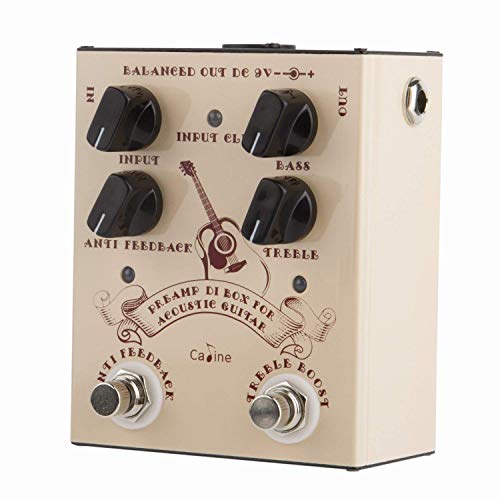
- Anti-feedback footswitch and true bypass
- Higher boost with volume control
- Compact 1/4-inch acoustic guitar format
Best For: Players wanting a compact acoustic preamp DI with footswitch control
Passive Signal Conversion

- Converts 1/4-inch input to balanced XLR
- No battery or phantom power required
- Ground lift and passive thru output
Best For: Stage or studio users needing a rugged single-channel passive DI
Full Acoustic Tone Control

- Adjustable gain for passive and active pickups
- Five-band EQ with notch and midrange controls
- XLR and 1/4-inch outputs with battery or phantom power
Best For: Players seeking detailed acoustic pickup shaping and feedback control
Two-Channel Routing

- Two-channel passive DI design
- Mono/stereo switch for flexible routing
- Die-cast metal housing with high-impedance inputs
Best For: Stereo or multi-channel instrument setups needing passive DI routing
Versatile Acoustic Control
L.R. Baggs Venue DI Acoustic Guitar Preamp and DI
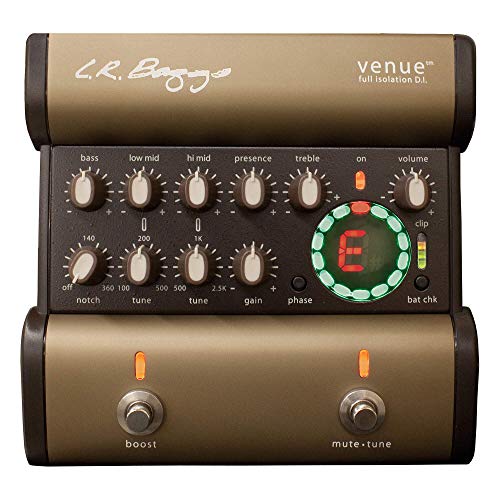
- Gain works with passive and active pickups
- Five-band EQ with tunable mid bands
- Includes tuner, notch filter, and boost
Best For: Players wanting extensive acoustic stage control
Piezo-Focused Signal Matching
Radial StageBug SB-4 Active Instrument Direct Box
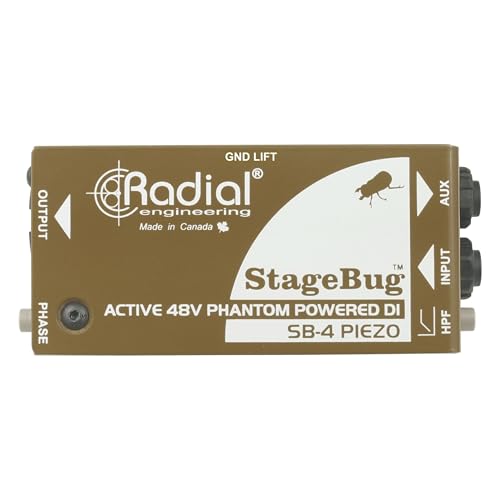
- Designed for piezo pickups
- 1/4-inch and XLR connectivity
- Adds auxiliary output, HPF, and polarity switch
Best For: Simple piezo-to-PA signal routing
Built-In Acoustic Preamp
Jiayouy EQ-7545R 4-Band Acoustic Guitar Preamp

- Four-band EQ for onboard tone adjustment
- Pre-wired with a 2.5mm connecting plug
- Includes a holder for a 9-volt battery
Best For: DIY acoustic and cigar box guitar installations
Practical Passive Choice

- High-impedance 1/4-inch input with Thru
- Balanced XLR output and ground lift
- -15 dB pad for high-level sources
Best For: Simple piezo-to-PA and recording setups
Premium Hum-Control Option
Radial JDI Jensen-equipped Passive DI
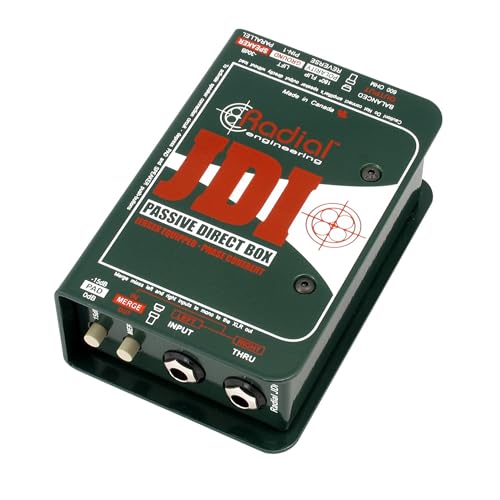
- Jensen transformer for signal isolation
- Reduces buzz and ground-loop hum
- Virtually zero phase and harmonic distortion
Best For: Quiet, clean professional piezo signal paths
Versatile Budget Connector

- 1/4-inch input with impedance transformer
- Balanced and unbalanced XLR support
- Input attenuation and hum cancellation
Best For: Flexible guitar, bass, and keyboard connections
Compact Acoustic Preamp – Caline CP-40 DI-Box
For players comparing di boxes for piezo acoustic pickups, the Caline CP-40 combines a preamp, DI function, and anti-feedback footswitch in a compact pedal format. Its volume control and higher boost make it a practical choice when you want to shape and strengthen an acoustic guitar signal.
Best For: Acoustic guitarists who want a compact, footswitchable preamp DI with added boost.
Pros:
- Includes an anti-feedback footswitch and true bypass.
- Offers higher boost for strengthening the guitar signal.
- Compact enclosure with a simple volume knob.
- Uses a standard 1/4-inch audio connection.
Cons:
- Requires a 9V power source and is corded electric.
- The supplied controls list only volume, limiting adjustment flexibility.
The CP-40 is a straightforward option for live acoustic setups that need basic signal enhancement and feedback control without a larger preamp unit.
Passive Signal Conversion – Samson S-Max MD1 Passive DI
The Samson S-Max MD1 is a passive choice for di boxes for piezo acoustic pickups, converting a 1/4-inch instrument-level signal to a balanced mic-level XLR output. It adds ground-lift and thru-output features for reducing hum and routing a dry signal to an amp or pedals.
Best For: Acoustic performers and studios needing a durable passive DI with XLR output and signal thru.
Pros:
- Operates without batteries or phantom power.
- Provides balanced XLR output from a 1/4-inch input.
- Ground-lift switch helps address buzz and hum.
- Thru output supports pedals, amplifiers, or monitoring.
Cons:
- Passive design does not provide preamp gain or EQ controls.
- Its single-channel layout may not suit stereo sources.
With a steel chassis, transformer-based circuitry, and practical routing options, the MD1 fits users who need clean, uncomplicated signal balancing rather than acoustic tone shaping.
Full Acoustic Tone Control – LR Baggs Para Acoustic D.I.
The LR Baggs Para Acoustic D.I. is a feature-rich option among di boxes for piezo acoustic pickups, with adjustable gain for passive and active pickups, five-band EQ, a tunable notch and midrange section, and phase inversion. It also offers both XLR and 1/4-inch outputs.
Best For: Acoustic guitarists who need detailed pickup matching, EQ, feedback control, and flexible output options.
Pros:
- Works with both passive and active pickups.
- Provides five-band EQ with tunable notch and midrange controls.
- Phase inversion supports sound shaping and feedback control.
- Runs on a 9V battery or 48V phantom power.
Cons:
- Its broader control set may take longer to configure.
- At 0.67 kg, it is less lightweight than simpler DI boxes.
The Para Acoustic D.I. is the strongest fit here for players who want a dedicated acoustic front end with extensive tone and feedback-management tools rather than only signal balancing.
Two-Channel Routing – Stagg SDI-ST Passive DI Box
Stagg 2 Channel Passive DI Box With Mono/Stereo Switch SDI-ST | Mono/Stereo Switch
Check Price On AmazonThe Stagg SDI-ST offers two-channel passive DI routing for players considering di boxes for piezo acoustic pickups. Its die-cast metal housing includes high-impedance inputs and a mono/stereo switch, making it useful when connecting instruments to a mixing console or amplifier.
Best For: Musicians who need two-channel passive routing and selectable mono or stereo operation.
Pros:
- Provides two mixer channels in one DI box.
- Includes a mono/stereo switch for flexible signal routing.
- High-impedance inputs accommodate pickups and instruments.
- Die-cast metal housing is compact and durable.
Cons:
- Passive design does not include preamp gain or EQ.
- The supplied notes do not specify battery or phantom-power operation.
The SDI-ST makes the most sense for multi-channel setups or stereo-capable rigs where robust passive routing matters more than onboard acoustic tone shaping.
Versatile Acoustic Control – L.R. Baggs Venue DI Acoustic Guitar Preamp and DI
The L.R. Baggs Venue DI is a feature-rich choice for players comparing DI boxes for piezo acoustic pickups. Its adjustable gain, five-band EQ, notch filter, tuner, and volume boost provide practical control for shaping an acoustic signal and managing feedback.
Best For: Acoustic guitarists who want an all-in-one preamp, DI, tuner, and feedback-control solution.
Pros:
- Adjustable gain supports both passive and active pickups.
- Five-band EQ includes tunable low-mid and high-mid bands.
- Built-in chromatic tuner, mute function, notch filter, and boost footswitch add stage utility.
Cons:
- Its broader feature set may be more than users seeking a simple DI box need.
- Requires a 9-volt battery-powered setup.
Choose the Venue DI when detailed tone shaping and performance controls matter as much as direct connection. It is a compact, analog unit with a neutral/balanced sound profile and a practical stage-oriented layout.
Piezo-Focused Signal Matching – Radial StageBug SB-4 Active Instrument Direct Box
The Radial StageBug SB-4 is a focused option among DI boxes for piezo acoustic pickups. This one-channel active direct box includes a 1/4-inch auxiliary output, a high-pass filter, and a polarity switch for practical instrument-to-PA signal management.
Best For: Piezo-equipped acoustic instruments needing a straightforward active DI with useful output and signal-control features.
Pros:
- Designed with piezo pickups in mind.
- Provides both 1/4-inch and XLR connectivity.
- Includes a 1/4-inch auxiliary output, high-pass filter, and polarity switch.
Cons:
- One channel limits it to a single instrument signal at a time.
- Does not offer the extensive EQ and tuner features found on larger acoustic preamps.
The SB-4 makes sense when compatibility with piezo sources and simple routing are the priorities. Its natural sound profile and two-year warranty further support its role as a practical, dedicated active direct box.
Built-In Acoustic Preamp – Jiayouy EQ-7545R 4-Band Acoustic Guitar Preamp
The Jiayouy EQ-7545R is an onboard preamp and equalizer rather than a conventional external DI box, making it a different option for piezo acoustic pickup setups. Its four-band EQ, tuner, pre-wired connections, and 9-volt battery holder are aimed at acoustic and cigar box guitar installation.
Best For: DIY builders and players installing an onboard piezo preamp in an acoustic or cigar box guitar.
Pros:
- Four-band equalizer allows bass, middle, and treble adjustment.
- Pre-wired design includes a connecting wire with a 2.5mm plug.
- Built-in holder accepts a 9-volt battery.
Cons:
- It is an internal preamp assembly, not a standalone stage DI box.
- The 9-volt battery is not included.
- Uses a 2.5mm jack rather than the 1/4-inch and XLR connections common on external DIs.
Consider the EQ-7545R when the goal is to add onboard tone shaping to a compatible guitar. For direct connection to a mixer or PA without installation, a dedicated external DI will be a more appropriate category match.
Practical Passive Choice – Mackie MDB-1P
The Mackie MDB-1P is a straightforward option for di boxes for piezo acoustic pickups when you need to send a high-impedance instrument signal to a mixer or PA. Its 1/4-inch input, Thru output, balanced XLR output, and ground lift support common live and recording setups.
Best For: Players needing a compact passive DI with high-impedance input and flexible output routing.
Pros:
- High-impedance 1/4-inch input with Thru output
- Balanced male XLR output and ground lift
- Ultra-low noise and distortion, with a -15 dB pad for high-level sources
- Built-like-a-tank construction
Cons:
- Single-channel design
- Passive format may be less suitable when you specifically need active DI features
For a piezo-equipped acoustic rig, the MDB-1P stands out for its high-impedance input and practical signal-routing options. The pad adds useful headroom for stronger sources, while the ground lift can help address connection noise.
Premium Hum-Control Option – Radial JDI Jensen-equipped Passive DI
The Radial JDI is a one-channel passive direct box to consider among di boxes for piezo acoustic pickups, particularly when hum and ground-loop noise are concerns. Its Jensen transformer is designed for clean instrument-to-mixer connections with minimal tonal artifacts.
Best For: Players and engineers prioritizing ground-loop isolation and exceptionally clean passive signal conversion.
Pros:
- Jensen transformer-equipped design
- Helps eliminate buzz and hum from ground loops
- Virtually zero phase and harmonic distortion
- Stainless steel construction
Cons:
- Single-channel format
- Heavier than the other listed options at 1.79 pounds
The JDI is a focused choice for a clean, quiet piezo signal path. Its transformer-based isolation and low distortion make it especially appealing for professional live or recording environments where unwanted hum is unacceptable.
Versatile Budget Connector – Pyle PDC21 Passive DI Unit
The Pyle PDC21 offers a flexible, budget-oriented approach to di boxes for piezo acoustic pickups. Its 1/4-inch connector, impedance transformer, balanced and unbalanced XLR compatibility, input attenuator, and hum-cancellation function support guitars and other unbalanced sources.
Best For: Home, rehearsal, and live setups needing broad connection compatibility and basic hum reduction.
Pros:
- 1/4-inch instrument connector with impedance transformer
- Supports balanced and unbalanced XLR connections
- Input attenuator and ground-lift hum cancellation
- Works with guitars, basses, keyboards, processors, and consumer stereo outputs
Cons:
- Passive, single-unit design rather than a multi-channel solution
- The supplied notes do not specify detailed frequency-response or distortion performance
The PDC21 is the most connection-focused option in this group. It makes sense when versatility and basic signal cleanup matter more than documented premium transformer specifications or detailed performance figures.
How We Picked These Di Boxes for Piezo Acoustic Pickups
We focused on signal compatibility, connectivity, live usability, and the features that matter most with piezo-equipped acoustic guitars. The selection includes passive and active DI designs, acoustic preamp/DI units, compact stage boxes, and pickup preamps with built-in equalization.
We also considered high-impedance instrument inputs, balanced outputs, attenuation options, ground-lift or hum-reduction functions, power requirements, and practical controls for shaping an acoustic signal. Because these products serve different roles, the best choice depends on whether you need simple signal conversion or a complete acoustic front end.
Quick Comparison
| Type | Best for | What to prioritize |
|---|---|---|
| Passive DI | Simple live rigs and bass-style signal conversion | Transformer quality, input handling, ground isolation |
| Active DI | Piezo pickups and detailed acoustic signals | High input impedance, clean headroom, reliable power |
| Acoustic preamp/DI | Players who need tone shaping and feedback control | EQ, gain, notch filtering, phase, tuner, and balanced output |
| Pickup preamp | Budget installations or onboard-style control | Pickup compatibility, battery use, installation format, and controls |
Key Buying Factors for Di Boxes for Piezo Acoustic Pickups
Input Impedance
Piezo pickups generally perform best with a suitably high-impedance input. A mismatch can reduce bass, emphasize harsh upper mids, and make the guitar feel less natural. Check the manufacturer’s input specifications when tone quality is a priority.
Passive or Active Design
Passive boxes are usually simple, durable, and do not require batteries or phantom power, but active models can offer stronger buffering and better flexibility for piezo sources. An active acoustic preamp is often preferable when the pickup sounds thin or needs substantial shaping.
Controls and Feedback Management
Basic DI boxes mainly convert an unbalanced instrument signal to balanced output. If you play at higher volume, look for EQ, phase reversal, notch filtering, gain control, or a tuner. These features can be more valuable than a minimal DI when managing feedback onstage.
Connections, Power, and Noise Control
Confirm that the unit has the inputs and outputs your rig requires, including 1/4-inch instrument input, XLR output, thru output, stereo switching, or attenuation. Ground lift and transformer isolation can help reduce hum, while active units may depend on phantom power, batteries, or an external supply.
Who Should Buy Which Di Boxes for Piezo Acoustic Pickups?
Choose a compact passive model if you only need to send an acoustic guitar to a mixer or PA and already like your instrument’s tone. Pick an active DI when your piezo pickup needs a cleaner buffer, more headroom, or stronger compatibility with professional stage systems.
Players who perform regularly should consider an acoustic preamp/DI with EQ and feedback tools, especially for loud stages or varied venues. A model with a tuner and direct controls can simplify the entire signal chain. Choose a pickup preamp when you specifically need onboard-style equalization or are upgrading a compatible piezo installation. For studio or high-end live use, prioritize build quality, transparent signal handling, and dependable isolation over the lowest price.