The right stereo audio equalizer can correct room response, refine vocals and instruments, and give you more control over a home, car, or DJ system. The best choice depends on more than the number of bands: connection type, signal level, installation space, and adjustment style all matter.
We selected 10 options ranging from compact car preamps and Bluetooth-equipped units to rack-mount graphic equalizers with spectrum displays. Use the guide below to narrow the field by system compatibility, control, and intended use.
Best 10 Stereo Audio Equalizers Picks for 2026
Professional Control
EQ-231 31-Band Stereo Graphic Equalizer

- 31 bands per channel for detailed tuning
- Low-cut filter and bypass switch
- XLR and 1/4-inch connectivity
Best For: Home audio, studio, live, and installation use
Car Audio Tuning
SKA7EQ 7-Band Pre-Amp Equalizer
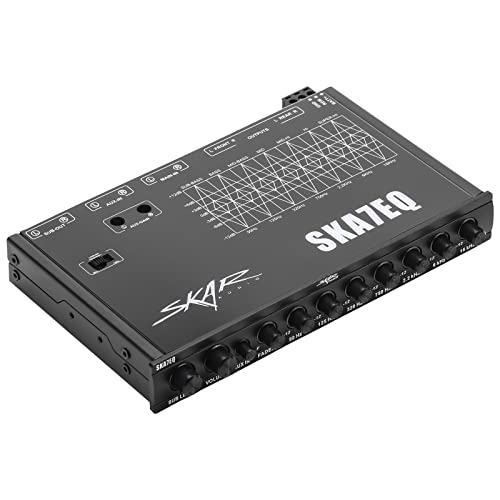
- Seven ±12dB adjustable bands
- Front, rear, and subwoofer RCA outputs
- Aux input and up to 7V output
Best For: Multi-amplifier car audio systems
Visual Home Theater Mixing
REQ42-S 42-Band Home Theater Equalizer
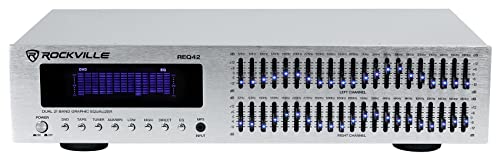
- 21 bands per channel
- Front source selector and 3.5mm input
- VU meters and multicolor LED display
Best For: Feature-rich home theater systems
High-Output Car Audio
EQX764 7-Band Line-Driver Equalizer

- Four inputs and six outputs
- Dedicated subwoofer level and frequency controls
- Up to 10 VRMS output
Best For: Complex multi-amplifier car audio installations
Best Compact Wireless Pick

- Five independently processed frequency bands
- Bluetooth 5.0 for wireless streaming
- Adjustable dual VU meters
Best For: Compact home stereo and computer-speaker systems
Best for Rack Systems
15-Band Stereo Graphic Equalizer
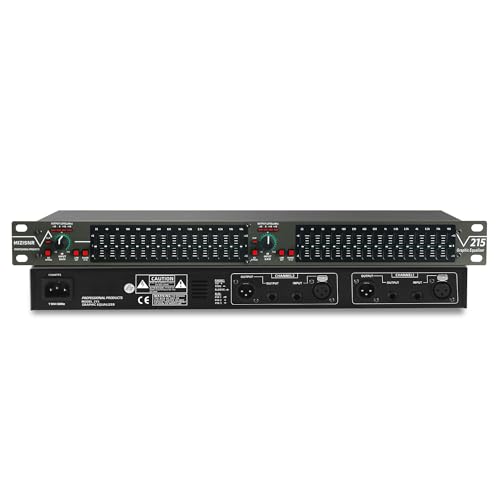
- 15 bands per channel with ±12dB adjustment
- Low-cut filter reduces unwanted low-frequency noise
- XLR and 1/4-inch connectivity in a 1U rack design
Best For: Rack-based home audio, studio, and live setups
Best Balanced Hi-Fi Option

- Seven bands with ±6dB adjustment
- Simultaneous XLR and RCA input/output
- High SNR and low specified distortion
Best For: Home stereo systems needing balanced connectivity
Most Versatile
31-Band Bluetooth Graphic Equalizer

- 31-band tuning with real-time spectrum monitoring
- Bluetooth, optical, coaxial, and USB connectivity
- 12 customizable modes with auto-save presets
Best For: Flexible home, studio, DJ, and live audio systems
Best for HiFi Simplicity
Nobsound 9-Band Stereo EQ Preamp

- Nine bands from 20Hz to 16kHz
- 111dB SNR and 0.001% THD
- Two RCA inputs and outputs with bypass and balance controls
Best For: RCA-based home stereo systems and audiophile listening
Best Rack-Mount Option
Professional 31-Band Digital Equalizer

- 31-segment LED spectrum display with 10 presets
- Bluetooth 5.2 and USB playback
- XLR, TRS, and adjustable bass output connections
Best For: Rack-mounted studios, venues, DJ systems, and installations
Professional Control – EQ-231 31-Band Stereo Graphic Equalizer
For listeners and audio professionals comparing stereo audio equalizers, the EQ-231 offers detailed control with 31 adjustable bands per channel. Its balanced and unbalanced connections, low-cut filter, bypass switch, and LED monitoring make it suitable for careful system tuning.
Best For: Home audio systems, studios, live applications, and audio installations requiring extensive stereo frequency control.
Pros:
- 31 bands per channel with adjustable ranges up to ±12dB.
- Low-cut switch helps reduce wind noise, floor rumble, and electrical hum.
- XLR balanced and 1/4-inch TRS unbalanced inputs and outputs support varied setups.
- LED ladders provide visual feedback for gain reduction and output levels.
Cons:
- The 18.9-inch-wide chassis may require dedicated rack or shelf space.
- Its professional controls may be more than casual listeners need.
The EQ-231 is the most adjustment-focused option in this group. Choose it when fine-grained stereo shaping and flexible connectivity matter more than compact size.
Car Audio Tuning – SKA7EQ 7-Band Pre-Amp Equalizer
Among stereo audio equalizers designed for vehicles, the Skar Audio SKA7EQ combines seven adjustable bands with front, rear, and subwoofer outputs. Its auxiliary input, fader control, and high-voltage RCA outputs give installers practical control over a multi-zone car audio system.
Best For: Car audio upgrades that need a 1/2 DIN equalizer, multiple RCA outputs, and dedicated subwoofer level control.
Pros:
- Seven bands adjust from -12dB to +12dB across bass, midrange, and treble frequencies.
- Front, rear, and subwoofer RCA outputs support system expansion.
- Aux input includes variable gain control.
- High-voltage outputs reach up to 7V, with 100dB signal-to-noise ratio.
Cons:
- Designed specifically for car audio rather than home stereo use.
- Installation requires mounting and wiring inside the vehicle.
With its compact 1/2 DIN format and dedicated outputs, the SKA7EQ is a sensible choice for drivers building a controllable multi-amplifier system.
Visual Home Theater Mixing – REQ42-S 42-Band Home Theater Equalizer
Rockville REQ42-S 2 x 21 Band Home Theater Equalizer w/Audio Spectrum Analyzer
Check Price On AmazonThe Rockville REQ42-S is one of the more feature-oriented stereo audio equalizers for home theater setups, pairing 21 bands per channel with visual monitoring. Front-panel source selection, an MP3 input, record output, and spectrum-style displays make it convenient for shared home audio systems.
Best For: Home theater and stereo systems where source switching, front-panel inputs, and visual level monitoring are useful.
Pros:
- Dual-channel 21-band design provides 42 total graphic bands.
- Front-panel selector supports DVD, tape, tuner, and auxiliary/MP3 sources.
- Includes a front 3.5mm input and RCA stereo record output.
- LED indicators, VU meters, and a multicolor display provide visual feedback.
Cons:
- Its 19-inch-wide chassis may be bulky for smaller entertainment centers.
- The listed 80dB signal-to-noise ratio is lower than some car-focused options here.
The REQ42-S favors hands-on operation and visual feedback over minimalism. It fits users who want multiple front-accessible sources and an engaging control-panel layout.
High-Output Car Audio – EQX764 7-Band Line-Driver Equalizer
For car audio builders comparing stereo audio equalizers with signal-routing flexibility, the Stetsom EQX764 provides seven bands, four inputs, and six outputs. Its dedicated subwoofer controls and outputs up to 10 VRMS make it suited to systems using multiple amplifiers.
Best For: Custom car audio installations requiring several sources, multiple amplifier outputs, and independent subwoofer control.
Pros:
- Seven adjustable bands cover 50Hz through 16kHz with a 12dB range.
- Four inputs and six outputs support up to four sources and six amplifiers.
- Dedicated subwoofer level and frequency controls simplify bass management.
- Up to 10 VRMS output can function as a line driver.
Cons:
- Its broad input/output configuration may be unnecessary for simpler systems.
- It is intended for car audio installation rather than home stereo setups.
The EQX764 stands out for routing capacity and subwoofer adjustment. It is a strong match for elaborate vehicle systems where output voltage and amplifier connectivity are priorities.
Best Compact Wireless Pick – 5-Band Bluetooth EQ Preamp
The Douk Audio EQ5 Tone is a practical choice for listeners who want compact stereo audio equalizers with wireless streaming and visual level monitoring. Its five independently processed bands cover key bass, midrange, and treble frequencies, while the bypass and balance controls make everyday adjustment straightforward.
Best For: Home stereo or computer-speaker setups that benefit from Bluetooth, compact construction, and a VU-meter display.
Pros:
- Five adjustable bands at 75Hz, 400Hz, 800Hz, 4kHz, and 10kHz.
- Bluetooth 5.0 supports convenient wireless music streaming.
- Dual 45mm VU meters include adjustable speed, brightness, and gain on the upgraded version.
- Compact metal housing includes bypass, balance, and gold-plated connections.
Cons:
- Five bands provide less detailed control than the 15-band alternative.
- Requires a DC 5V power source.
Choose this model when convenience and visual appeal matter as much as basic tone shaping. It is especially well suited to smaller listening systems where Bluetooth connectivity and a compact footprint are useful.
Best for Rack Systems – 15-Band Stereo Graphic Equalizer
For more detailed system tuning, this EQ-215 provides the broadest adjustment range among these stereo audio equalizers. Its dual 15-band layout, low-cut filter, bypass switch, and rack-mount design make it a fit for home audio installations, studios, and live applications.
Best For: Users who need extensive dual-channel control and flexible balanced or unbalanced connections in a rack-based setup.
Pros:
- 15 adjustable bands per channel with up to ±12dB of control.
- Low-cut switch helps reduce wind noise, floor rumble, and electrical hum.
- Supports XLR balanced and 1/4-inch TRS unbalanced inputs and outputs.
- Standard 1U rack-mount format simplifies installation.
Cons:
- Its 18.9-inch-wide rack format is less suitable for compact desktop systems.
- More controls may be unnecessary for listeners seeking simple tone adjustments.
This is the strongest option when precision and installation flexibility take priority. The dual-channel 15-band design offers considerably more shaping capability than compact home-oriented units.
Best Balanced Hi-Fi Option – 7-Band XLR/RCA EQ Preamp
The Douk Audio T7 is a streamlined choice among stereo audio equalizers for systems that need balanced and unbalanced connectivity. Its seven frequency bands provide focused tone shaping, while the high signal-to-noise ratio and low distortion are designed for clear signal reproduction.
Best For: Home stereo users who need XLR and RCA integration with straightforward, fixed-level operation.
Pros:
- Seven bands cover 64Hz through 8kHz with ±6dB adjustment.
- XLR and RCA inputs and outputs operate simultaneously.
- Specified SNR exceeds 104dB with distortion as low as 0.003%.
- Compact aluminum housing helps shield against interference.
Cons:
- No volume control knob; it outputs at the rated level.
- Offers less adjustment range and fewer bands than the EQ-215.
The T7 makes sense for a clean, uncomplicated installation where connection flexibility is important. Its lack of a volume knob is a limitation for some systems, but an advantage for buyers who prefer a simple signal path and dedicated amplifier volume control.
Most Versatile – 31-Band Bluetooth Graphic Equalizer
For shoppers comparing stereo audio equalizers, this 31-band model stands out as a flexible hub for home and professional systems. It combines real-time frequency monitoring, 12 customizable modes, noise and echo reduction, Bluetooth connectivity, optical and coaxial inputs, USB playback, and broad device compatibility.
Best For: Home theaters, KTV systems, studios, DJ setups, live venues, and users who want detailed control across multiple audio sources.
Pros:
- 31 independently tunable bands cover bass through treble.
- Real-time spectrum analysis helps visualize frequency changes.
- Supports Bluetooth, optical, coaxial, and USB connections.
- Auto-save presets simplify switching between music, movies, and live sound.
Cons:
- The extensive controls may be more than casual listeners need.
- The supplied notes do not specify detailed input/output connector layouts.
This is a strong all-around choice when you need stereo audio equalizers with deep adjustment options and flexible connectivity. Its portability also makes it useful for moving between permanent installations and live setups.
Best for HiFi Simplicity – Nobsound 9-Band Stereo EQ Preamp
This Nobsound model is a compact option among stereo audio equalizers for listeners who want focused tone shaping in an existing RCA-based system. Its nine bands span 20Hz to 16kHz, while the high signal-to-noise ratio and low distortion are designed to preserve detail and clarity.
Best For: Home stereo audiophiles using active speakers, amplifiers, CD players, computers, or preamplifiers with RCA connections.
Pros:
- Adjusts nine frequency bands within a ±6dB range.
- 111dB SNR supports a clean background and broad dynamic range.
- 0.001% THD is designed to preserve sound clarity.
- Includes two RCA inputs and outputs, tone controls, bypass, and balance adjustment.
Cons:
- Offers fewer adjustment bands than 31-band alternatives.
- Connectivity is centered on RCA rather than Bluetooth or digital inputs.
Choose this EQ9 when straightforward analog integration and low-noise performance matter more than extensive connectivity. Its slim aluminum-alloy design can fit neatly into a conventional home stereo setup.
Best Rack-Mount Option – Professional 31-Band Digital Equalizer
Among stereo audio equalizers, this professional 31-band unit is aimed at installations that benefit from visual monitoring and rack integration. It adds 10 preset modes, EQ bypass, LED spectrum indication, intelligent noise reduction, Bluetooth 5.2, USB playback, and multiple balanced and unbalanced connection options.
Best For: Rack-mounted home theaters, KTV venues, recording studios, DJ equipment, live applications, and fixed audio installations.
Pros:
- 31-segment LED display provides real-time frequency visualization.
- Supports 10 saved preset effects plus EQ bypass for easier testing.
- Offers Bluetooth 5.2 and USB lossless music playback.
- Includes XLR balanced, 1/4-inch TRS unbalanced, and independent adjustable bass output options.
Cons:
- At 4.44 pounds, it is less portable than compact equalizers.
- The rack-mount design may be unnecessary for simple desktop systems.
- Its broad configuration may require more setup time for beginners.
This model makes the most sense when you need installation-ready stereo audio equalizers with prominent visual feedback and versatile signal routing. The bypass switch and rack format are especially practical for system setup and troubleshooting.
How We Picked These Stereo Audio Equalizers
We focused on models that provide meaningful tone-shaping control for stereo systems, rather than simple bass-and-treble controls. The selection includes 5-, 7-, 9-, 15-, 21-, and 31-band designs, covering casual home listening, car audio installation, DJ use, and more precise room or system tuning.
We also considered connection flexibility, including RCA, high-level, XLR, Bluetooth, auxiliary, and preamp configurations. Features such as spectrum analyzers, VU meters, line drivers, noise reduction, rack-mount construction, and balanced outputs can be useful, but only when they fit the rest of your signal chain.
Quick Comparison
- Home stereo: Choose a unit with RCA inputs and outputs, straightforward front-panel controls, and a noise specification suited to your amplifier.
- Car audio: Look for 12-volt compatibility, a suitable DIN or dash format, high-level or RCA inputs, and enough outputs for your amplifier layout.
- DJ or rack systems: A 15- or 31-band model with dual-channel controls, rack mounting, and visible metering is often the most practical.
- Computer or Bluetooth listening: Compact preamp-style models with Bluetooth, auxiliary, or USB-adjacent connectivity can reduce the need for extra components.
- Advanced installations: Balanced XLR connections, high-voltage outputs, and multiple outputs help with long cable runs and multi-amplifier systems.
Key Buying Factors for Stereo Audio Equalizers
Band Count and Adjustment Range
More bands allow finer correction, but they also create more opportunities for poor settings. Five to nine bands are usually sufficient for broad tonal changes, while 15 or 31 bands are better for detailed system tuning. Check the frequency centers and boost/cut range, not just the advertised band count.
Inputs, Outputs, and Signal Level
Confirm that the equalizer matches your sources and amplifier. RCA is common in home systems, while XLR may be preferable for balanced equipment. Car models may accept high-level speaker signals or provide higher-voltage RCA outputs. Pay attention to the number of outputs if you run separate front, rear, or subwoofer amplifiers.
Noise, Headroom, and Bypass
An equalizer should add control without introducing audible hiss, hum, or clipping. Look for strong signal-to-noise performance, low distortion, appropriate input sensitivity, and a bypass function that lets you compare processed and unprocessed sound. A line driver can help some car systems, but it cannot fix incorrect gain staging.
Form Factor and Controls
Measure the available space before buying. Rack-mount units suit equipment racks and DJ setups, whereas compact preamp models work better on a desk or shelf. Physical sliders provide immediate control; digital displays and presets may be more convenient for repeatable settings.
Who Should Buy Which Stereo Audio Equalizers?
Choose a 31-band model if you want detailed room or system correction and are comfortable making careful adjustments. Choose a 15- or 21-band rack unit for a practical balance of precision and manageable controls in home theater or DJ systems. Choose a compact 5- to 9-band preamp for simple home listening, computer audio, or basic tonal shaping. Choose a dedicated car equalizer when your system needs dash-friendly installation, high-level compatibility, multiple outputs, or additional preamp voltage. Finally, choose Bluetooth, VU-meter, or spectrum-analyzer features for convenience and monitoring—not as substitutes for correct wiring, gain settings, and speaker placement.