The best voice recorders for musicians make it easier to capture rehearsals, song ideas, live performances, and clean production audio wherever inspiration strikes.
This roundup covers compact stereo recorders, 32-bit-float models, XLR-capable devices, lavalier systems, and simple dictation recorders so you can match features to your workflow and budget.
Best 10 Voice Recorders for Musicians Picks for 2026
Best All-Around Recorder

- 32-bit float recording for clip-free audio
- Built-in stereo mics and two XLR/TRS inputs
- USB-C recording with SD card backup
Best For: Musicians needing flexible inputs for varied recording setups
Best Microphone-Mounted Option

- Attaches directly to handheld XLR microphones
- Dual Recording provides a lower-level backup
- Supports WAV and MP3 files
Best For: Portable mono recording with an XLR handheld microphone
Best Modular Bundle

- 32-bit float recording for dynamic sources
- Detachable XY capsule supports modular recording
- Includes 64GB card and four AA batteries
Best For: Mobile musicians wanting a ready-to-use modular setup
Best Compact Stereo Recorder

- X/Y stereo microphones for music and ambience
- 32-bit float recording for clip-free capture
- USB-C microphone mode for calls and streaming
Best For: Portable recording of rehearsals, songwriting, and content
Best Personal Audio Pick

- Clip-on lavalier microphone included
- 32-bit float WAV recording
- Supports up to 512GB microSDXC
Best For: Discreet personal recording and multi-device workflows
Best Complete Starter Bundle
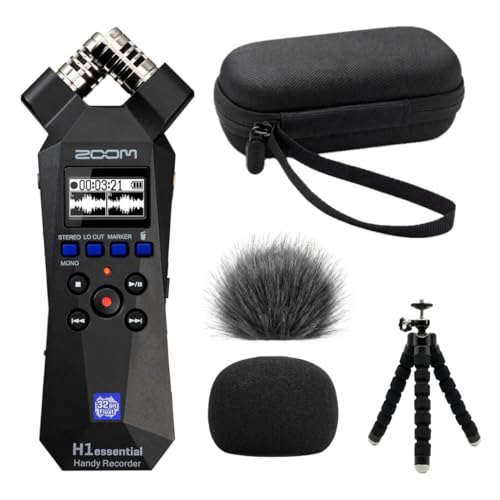
- Stereo X/Y microphones
- 32-bit float recording up to 96kHz
- Includes case, windscreens, and tripod
Best For: Portable music, voice, and field recording
Best Versatile Stereo Recorder

- Stereo 32-bit float recording
- X/Y microphones handle up to 130 dB SPL
- USB microphone and AAC/WAV modes
Best For: Rehearsals, concerts, demos, and mobile recording
Best Value Compact Recorder
EVISTR L357 64GB Digital Voice Recorder

- 64GB storage with long recording capacity
- PCM noise reduction and adjustable gain
- WAV/MP3 recording with voice activation
Best For: Songwriting ideas, rehearsals, lessons, and spoken notes
Best for Multitrack Music
Zoom H6 6-Track Portable Recorder

- Six-track recording with four XLR/TRS inputs
- 24-bit/96kHz WAV recording
- USB audio interface with phantom power
Best For: Multimicrophone rehearsals, performances, and music production
Best Budget Voice Recorder
HoTiyan 8GB Digital Voice Recorder

- Simple three-button recording operation
- Voice activation with noise-reduction microphone
- MP3/WAV support and A-B repeat playback
Best For: Budget-conscious beginners, students, and quick musical notes
Best All-Around Recorder – Zoom H4 Essential
The Zoom H4 Essential is a flexible choice among voice recorders for musicians who need to capture rehearsals, live performances, interviews, podcasts, or video audio. Its built-in stereo microphones, two XLR/TRS inputs, four-track recording, and 32-bit float capture support a broad range of setups.
Best For: Musicians and creators who need built-in microphones plus connections for external mics, instruments, mixers, or soundboards.
Pros:
- 32-bit float recording helps provide clip-free audio during changing volume levels.
- Built-in stereo microphones and two XLR/TRS inputs support multiple recording approaches.
- Can record to a device through USB-C while saving a backup to an SD card.
- Spoken menu guidance can make operation easier for visually impaired users.
Cons:
- Requires two AA batteries.
- Its broader feature set may be more than needed for simple stereo recordings.
Choose the H4 Essential if you want one recorder that can move from casual songwriting and field recording to more involved multi-source projects.
Best Microphone-Mounted Option – TASCAM DR-10X
The TASCAM DR-10X is a compact option among voice recorders for musicians who use an XLR handheld microphone. It attaches directly to the microphone, offers manual or automatic gain, and includes safety features for interviews, announcements, and other mono recordings.
Best For: Musicians, interviewers, and news gatherers who want a small recorder mounted directly to an XLR microphone.
Pros:
- Captive XLR connector attaches firmly to a handheld microphone.
- Dual Recording creates a lower-level backup to help protect against distortion.
- Automatic gain, low-cut filter, and limiter support easier level management.
- Supports WAV and MP3 recording with up to 120 hours of stated recording time.
Cons:
- Records in mono rather than stereo.
- Designed for XLR microphones, so it is less versatile as a standalone recorder.
- Requires one lithium metal battery.
The DR-10X makes the most sense when your recording workflow centers on a handheld XLR microphone and portability matters more than multiple inputs.
Best Modular Bundle – Zoom H5studio Bundle
The Zoom H5studio bundle is a practical pick among voice recorders for musicians who want a ready-to-use package. It includes a detachable XY microphone capsule, 32-bit float recording, a 64GB microSDHC card, four AA batteries, and an accessory pack for getting started quickly.
Best For: Musicians and mobile creators who value a modular microphone system and included recording accessories.
Pros:
- 32-bit float recording is designed to help manage sudden loud sound spikes.
- Detachable XY microphone capsule can be swapped with compatible modules.
- Bundle includes a 64GB microSDHC card and four AA batteries.
- Compact design supports field documentation, interviews, and other mobile recording work.
Cons:
- The supplied details list no headphone jack.
- Requires four AA batteries for power.
- The included XY capsule may not suit every recording environment without additional compatible modules.
If you want a flexible recorder package with storage and power included, the H5studio bundle offers a convenient starting point for mobile music and content work.
Best Compact Stereo Recorder – Zoom H1 Essential
The Zoom H1 Essential is a straightforward choice among voice recorders for musicians who want to capture songwriting sessions, rehearsals, acoustic performances, lessons, or ambient sound. Its X/Y stereo microphones, 32-bit float recording, and USB microphone mode keep it useful for both standalone recording and computer or mobile workflows.
Best For: Musicians and creators seeking a lightweight stereo recorder for quick musical ideas, rehearsals, and content production.
Pros:
- X/Y stereo microphones capture music, voices, ambience, and room sound.
- 32-bit float recording supports clip-free audio capture.
- USB-C microphone mode works for livestreams, calls, voiceovers, and desktop or mobile recording.
- Lightweight 92-gram design and a 3.5-millimeter headphone jack support portable use and monitoring.
Cons:
- Uses two AAA batteries.
- Built-in stereo microphones do not provide the external XLR/TRS inputs found on larger recorders.
- Stated digital recording time is 10 hours.
The H1 Essential is a strong fit when you want a small, uncomplicated recorder that can move easily from musical ideas to USB-based content recording.
Best Personal Audio Pick – TASCAM DR-10L Pro
For musicians who need discreet, hands-free voice recording, the TASCAM DR-10L Pro pairs a clip-on lavalier microphone with 32-bit float WAV recording. Its compact design suits rehearsals, performances, interviews, and other situations where a body-worn recorder is more practical than a handheld unit.
Best For: Musicians and creators who want stealthy personal recording with a matched lavalier microphone.
Pros:
- 32-bit float recording helps capture both quiet and loud sounds without manual gain adjustment.
- Includes a matched TM-10L clip-on lavalier microphone for clear personal audio.
- Supports microSDXC cards up to 512GB and offers optional LTC Jam Sync capabilities.
- The DR-10L Pro CONNECT app can control up to five simultaneous recordings.
Cons:
- Records in mono rather than stereo.
- The AK-BT1 Bluetooth adapter for Atomos wireless timecode is sold separately.
- Its lavalier-focused design is less suited to capturing a wide stereo instrument performance.
The DR-10L Pro is a specialized choice among voice recorders for musicians, prioritizing discreet, reliable personal audio over stereo room capture. Choose it when a clip-on microphone and synchronized multi-device workflows matter most.
Best Complete Starter Bundle – Zoom H1essential Bundle
The Zoom H1essential is a practical option for musicians seeking portable voice recorders for musicians with stereo capture and useful accessories included. Its X/Y microphones, 32-bit float recording, and bundled windscreens make it ready for vocals, instruments, interviews, and field recording.
Best For: Musicians who want an all-purpose stereo recorder with a case, windscreens, and flexible tripod.
Pros:
- 32-bit float recording helps reduce clipping and distortion during changing performances.
- Stereo X/Y microphones record audio up to 120 dB SPL and support sample rates up to 96kHz.
- Functions as a USB microphone with PC, Mac, iOS, and Android devices.
- Bundle includes a hard EVA case, furry and foam windscreens, and an octopus tripod.
Cons:
- Requires two AAA batteries.
- The included 0.96-inch screen is relatively small.
- Accessory quality and fit may vary because several bundle items are from 99KOLB rather than Zoom.
With stereo microphones and a useful five-item bundle, the H1essential offers a straightforward setup for practice sessions, demos, and mobile recording. It is especially appealing if you want protective and placement accessories without assembling a kit separately.
Best Versatile Stereo Recorder – Xvive XV1-R
The Xvive XV1-R combines stereo X/Y microphones, 32-bit float recording, and USB microphone functionality in a compact recorder. For musicians comparing voice recorders for musicians, its auto-record, pre-record, and high-SPL capability make it useful for rehearsals, concerts, demos, and mobile content creation.
Best For: Musicians who want a compact stereo recorder that also works for USB recording and streaming.
Pros:
- 32-bit float recording reduces the need for precise gain adjustment in high-dynamic-range situations.
- X/Y microphones capture stereo audio up to 130 dB SPL without distortion, according to the supplied specifications.
- Supports WAV recording up to 96kHz and also offers compressed AAC recording.
- USB-C microphone mode works with PC, Mac, iOS, and Android devices.
Cons:
- There is no headphone jack for direct monitoring.
- Maximum listed memory support is 128GB microSDXC.
- USB Audio Class 2.0 operation is fixed at a 48kHz sample rate.
The XV1-R is a flexible pick for musicians who want one compact device for stereo recording and computer or mobile audio. Its lack of a headphone jack is the main limitation for users who need direct monitoring while recording.
Best Value Compact Recorder – EVISTR L357 64GB Digital Voice Recorder
For musicians seeking voice recorders for musicians that are simple to carry and easy to operate, the EVISTR L357 offers substantial storage, adjustable recording gain, and PCM noise reduction. Its built-in microphone is suited to capturing rehearsals, ideas, lessons, and spoken notes, though it is designed more as a portable voice recorder than a multitrack music-production unit.
Best For: Musicians who want a compact recorder for songwriting ideas, rehearsal notes, lessons, and spoken reference recordings.
Pros:
- 64GB capacity stores up to 4,660 hours at 32Kbps.
- PCM noise reduction, stereo recording, and seven gain levels provide recording flexibility.
- Up to 32 hours of continuous recording and 35 hours of playback.
- Supports WAV and MP3, voice activation, A-B repeat, and variable-speed playback.
Cons:
- Uses a built-in microphone rather than external microphone inputs.
- Voice activation may not suit recordings where continuous sound is important.
- Its feature set is geared toward voice recording rather than multitrack music production.
The EVISTR L357 is a practical choice when portability, long battery life, and generous storage matter more than studio-style connectivity. Adjustable gain and WAV support make it more flexible than a basic dictaphone for capturing musical ideas and acoustic practice sessions.
Best for Multitrack Music – Zoom H6 6-Track Portable Recorder
The Zoom H6 is the strongest fit here for musicians who need dedicated audio-recording hardware rather than a basic dictaphone. It records up to 24-bit/96kHz WAV audio, includes stereo microphone capsules, and provides four XLR/TRS inputs with individual gain controls, pads, and phantom power.
Best For: Bands, solo performers, podcasters, and creators recording multiple microphones or instruments in stereo or multitrack formats.
Pros:
- Six-track portable recording capability with four XLR/TRS inputs.
- Records up to 24-bit/96kHz audio in WAV or MP3.
- Individual gain controls, pads, and phantom power support connected microphones.
- Functions as a multichannel or stereo USB audio interface for PC, Mac, and iPad.
Cons:
- More complex and less pocket-friendly than a simple voice recorder.
- Requires four AA batteries and records to an SD card.
- Additional mounting hardware is needed for direct DSLR or camcorder mounting.
For serious field recording and musical collaboration, the H6 offers substantially more input and audio-format flexibility than the other options. Its interchangeable included capsules and XLR/TRS connectivity make it the most capable choice for capturing rehearsals, live performances, and multi-source sessions.
Best Budget Voice Recorder – HoTiyan 8GB Digital Voice Recorder
The HoTiyan 8GB recorder is a low-cost option for musicians who mainly need a quick way to capture spoken ideas, lessons, or simple practice references. It combines a built-in stereo microphone with noise reduction, voice activation, playback controls, and MP3-player functionality in a compact design.
Best For: Beginners and students who need an inexpensive recorder for musical ideas, classes, meetings, or basic rehearsal documentation.
Pros:
- Simple three-button operation supports quick recording and saving.
- Voice activation can reduce silent sections and conserve storage.
- Records in MP3 or WAV and includes playback, A-B repeat, and variable speed.
- 8GB storage provides up to 128 hours at 192Kbps or longer at lower bitrates.
Cons:
- 8GB capacity is considerably smaller than the EVISTR L357’s 64GB.
- Built-in microphone and lack of XLR/TRS inputs limit use for advanced music recording.
- Battery supports up to 20 hours of continuous recording, according to the supplied specifications.
The HoTiyan is best viewed as an accessible voice-note recorder rather than a dedicated field recorder for high-quality ensemble work. Its straightforward controls and repeat functions make it useful for learning, songwriting reminders, and occasional practice recordings on a budget.
How We Picked the Best Voice Recorders for Musicians
We focused on recording quality, microphone versatility, portability, ease of use, storage, power options, and the type of musician each recorder serves best. Models with XLR or TRS inputs can work with external microphones and instruments, while compact stereo units are better for quick demos, rehearsals, and field recording.
We also considered modern conveniences such as 32-bit float recording, USB audio-interface functionality, built-in microphones, automatic recording, bundled accessories, and support for high-capacity memory cards. Basic dictation recorders are included for musicians who mainly need a simple tool for lyrics, lessons, or musical ideas rather than studio-quality audio.
Quick Comparison
| Best For | Recommended Type | Features to Prioritize |
|---|---|---|
| Song ideas and rehearsals | Compact stereo recorder | Built-in X/Y microphones, simple controls, low weight |
| Live performances and acoustic sessions | Higher-quality stereo recorder | Manual gain control, limiter, wind protection, reliable storage |
| Band practice and multitrack work | Multichannel handheld recorder | Multiple XLR/TRS inputs, overdubbing, strong battery life |
| Video and solo performance | Lavalier or 32-bit-float recorder | Clipping protection, compact mounting, timecode support where needed |
| Lyrics, lessons, and spoken notes | Digital voice recorder | Voice activation, playback, internal storage, USB transfer |
Key Buying Factors for Voice Recorders for Musicians
Microphone and Input Configuration
Built-in stereo microphones are convenient for recording a room, rehearsal, or acoustic instrument. Choose XLR/TRS inputs if you already own microphones, need phantom power, or want to connect a mixer, guitar output, or professional vocal microphone. A lavalier recorder is more specialized and works well for video, spoken introductions, and hands-free performance content.
Recording Format and Headroom
WAV is the preferred format for editing and mixing. AAC can save space for quick sharing. 32-bit float recording is useful when performance levels are unpredictable because it provides substantial editing headroom, but it does not replace good microphone placement or prevent every type of distortion.
Portability, Storage, and Power
Check the recorder’s size, battery type, expected battery life, memory-card compatibility, and whether a case, windscreen, tripod, or card is included. For concerts and long rehearsals, generous storage and dependable power matter as much as microphone specifications.
Controls and Connectivity
Large physical controls are helpful when starting and stopping takes quickly. USB connectivity can simplify file transfers and may allow the recorder to function as an audio interface. Headphone monitoring is especially valuable for checking noise, clipping, and microphone placement before an important take.
Who Should Buy Which Voice Recorders for Musicians?
Choose a compact stereo recorder if you want the fastest way to capture songwriting ideas, rehearsals, room sound, or acoustic performances. Choose an XLR-capable model for bands, vocalists, producers, and musicians who use external microphones or need more input flexibility. Choose a 32-bit-float recorder for unpredictable levels, location work, or video production where recovering from an overly quiet take is useful. Choose a lavalier system for wearable, hands-free audio paired with a camera. Choose a basic digital voice recorder for lyrics, spoken reminders, lessons, and casual references where studio fidelity is not the priority.